
Omnichannel AI should help a customer continue a request across calls, texts, and chat. Shared context is useful when the system can connect the right interactions, confirm identity where needed, and preserve the rules for what each person may see or change.
For customer experience (CX) and operations leaders, disconnected conversation records create extra work at the point of handoff. A customer may call in the morning, send a text in the afternoon, and open a web chat later. Each channel should contribute to a useful account of the request.
Keep the task connected
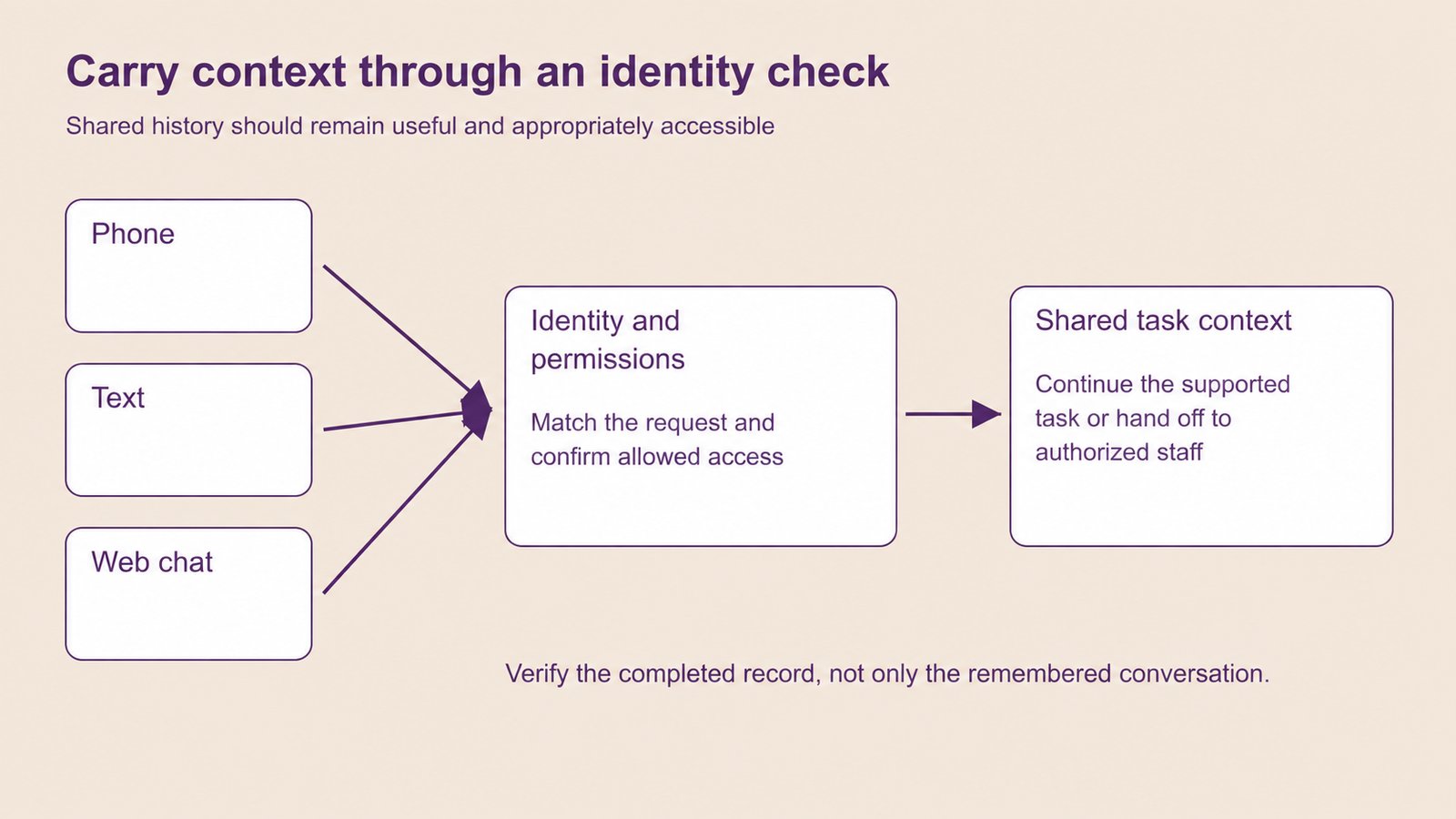
A connected workflow can carry relevant context between supported channels once the customer or conversation has been matched appropriately. The customer should not have to reconstruct the entire request simply because they changed the way they contacted the business.
Consider a customer who calls about an appointment and later sends a text asking, “Can we move that to Friday instead?” The system needs enough context to identify the request, along with the authority and connected-system access needed to make the change.
A new channel may still require identity checks before the system discloses information or changes an appointment. An anonymous browser session or a shared family phone number should not be treated as proof that the same person is asking.
What shared context should provide
Newo describes shared configuration, customer profiles, and conversation history across supported channels. Newo’s cross-channel messaging describes how supported conversations can share history.
Relevant context can continue across supported channels when identity matching and access rules allow it. This is a workflow capability, rather than a requirement that every channel run through a literal single model.
The NIST Privacy Framework offers a reference for assessing data-use and access risks across customer interactions. Decide what context may be reused, who may see it, and when a new identity check is required.
How to test omnichannel AI continuity
Follow one task from the first request through to the completed record. Include text messaging (SMS), phone, and web chat where those channels are enabled in your deployment.
Item |
What to record or do |
Check or owner |
|---|---|---|
Phone request |
Start an appointment-change request with a matched test customer. |
Confirm the task and permitted information are recorded. |
Text continuation |
Continue through the supported text channel. |
Verify context is linked only after the required identity checks. |
Web chat |
Continue in a new browser session or as an unmatched visitor. |
Confirm the system does not expose private history based on an unsupported identity assumption. |
Staff handoff |
Request staff help with the same task. |
Check that an authorized staff member receives the useful history and next action. |
Completion |
Check the connected appointment or service record. |
Verify the intended change and confirmation; memory alone is not completion. |
Run the test with both a correctly matched identity and an unmatched identity. Include a shared phone-number scenario if it occurs in your business. Record what context may be reused, when re-verification is required, and who resolves a failed match.
Give staff a useful handoff
Test whether the receiving staff member can access the relevant history under the organization’s permissions. A useful handoff gives the next person enough context to continue the request: what the customer asked for, what has already happened, and which action remains.
Information technology (IT) teams should verify the connected record and permissions as well as the conversation history. Remembering that a customer requested a change does not establish that the change succeeded.
Measure first-response time and subsequent reply time separately for each supported channel, and record the test conditions. Review task completion separately from response speed. A prompt answer can still leave the underlying request unresolved.
Judge continuity by the outcome
Customers may contact a business at any time, but the actions available can depend on the channel, supported integration, and access to staff. Define the fallback when context cannot be linked or a task cannot be completed.
The test should show that a matched customer can continue appropriately, an unmatched person cannot obtain private context, and staff can finish the requests that need their judgment.
Evaluate omnichannel AI by following a real task across channels. Check that context remains useful, identity and access rules still apply, and staff receive the information they need to complete a handoff.