The best AI answering service answers every call in your business's name, completes the caller's request within your systems, and hands off to a person when it should. You should also be able to predict the cost. Ten services fit that description in 2026, and they differ most on booking, integrations, compliance, and how they bill.
We wrote this comparison for operators with high call volume, often across several locations, who want to know what each service does and what it costs at volume. It also covers the cases where a live call center still makes more sense than AI.
Newo publishes this article and is one of the ten. It's an AI answering service (or, as we call it, a Voice AI employee), and we scored it on the same criteria as the others, using the same evidence: what each vendor publishes on its website.
How we compared the best AI answering services
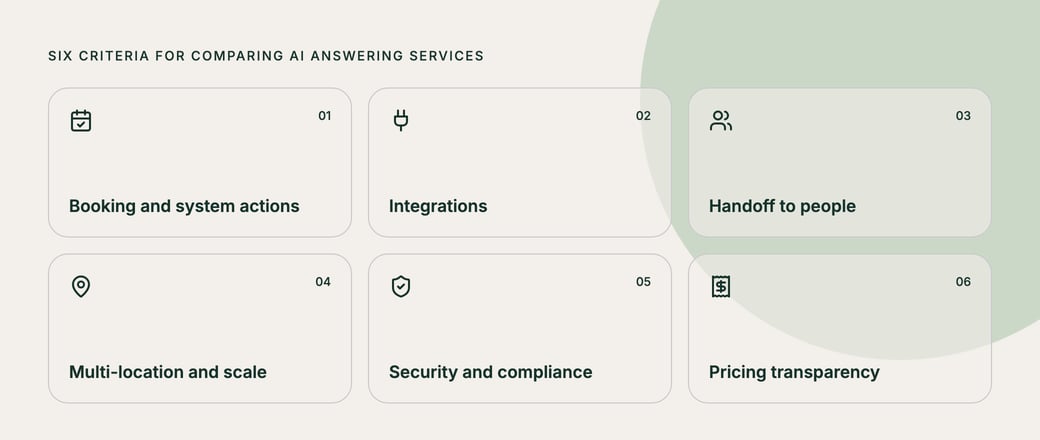
We checked each service against six criteria, using only what the vendor publishes on its own product, pricing, and security pages as of October 29, 2026. Where a vendor doesn't publish something, we say "not published" rather than guess. We didn't run paid test calls, so treat this as a shortlist and run your own calls before you sign anything (step 4 of the switch plan below covers how).
- Booking and system actions. Can it book, reschedule, or update a record in the systems you already use, or does it only take a message?
- Integrations. Which scheduling, CRM, practice management, and point-of-sale tools does the vendor name?
- Handoff to people. Can it transfer a live call, and does your team get context?
- Multi-location and scale. Can one setup answer for several sites, route by location, and report every call the same way?
- Security and compliance. What does the vendor publish about HIPAA, Business Associate Agreements (BAAs), SOC 2, and ISO 27001?
- Pricing transparency. Is there a public rate card, and what would 500 calls a month cost at list price?
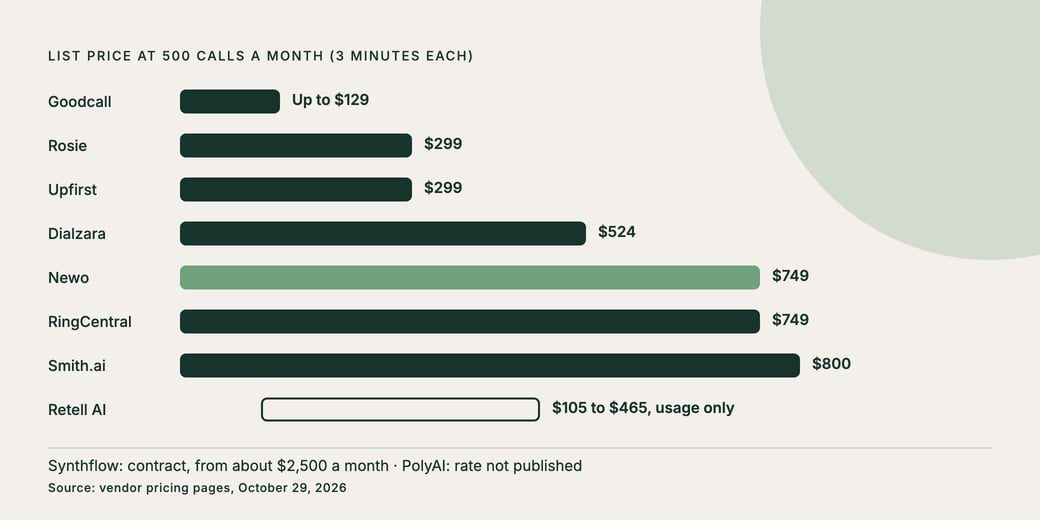
For the cost criterion, we used one worked example for every service: 500 calls a month, each lasting 3 minutes (1,500 minutes in total), on the cheapest published plan that covers it. Your real cost will differ with call length, repeat callers, add-ons, and contract terms.
The 10 AI answering services at a glance
The first table covers Newo and four self-serve AI receptionists. The second covers Newo alongside a hybrid AI and human service, a phone-system add-on, two voice agent platforms, and an enterprise contact-center option. Newo sits in the first column of both tables so you can compare it with each group; the column order isn't a ranking. Prices are list prices from each vendor's pricing page, checked on October 29, 2026.
| Newo | Rosie | Goodcall | Upfirst | Dialzara | |
|---|---|---|---|---|---|
| Type | Voice AI employee | Self-serve AI receptionist | Self-serve AI receptionist | Self-serve AI receptionist | Self-serve AI receptionist |
| Entry price | $0 to start (50 units); $299/mo for 200 units | $49/mo for 250 minutes | $79/mo for 100 unique customers | $24.95/mo for 30 calls | $29/mo for 60 minutes |
| How it bills | Units (one call of 30 seconds to 3 minutes each); $1.50 per extra unit; spam, immediate hang-ups, and unconnected calls not billed | Monthly minute bundles; overage not published | Unique callers; minutes not metered | Calls; $0.70 to $1.50 per extra call | Minutes; $0.35 to $0.48 per extra minute |
| 500 calls × 3 min at list price | $749/mo | $299/mo | Up to $129/mo | $299/mo | $524/mo |
| Books into your systems | Yes, writes bookings to your scheduler | Calendar booking on $149 plan and up | Yes, Google Calendar named | Yes, booking and calendar integrations named | Yes |
| SMS | Yes, SMS AI agent | In-call texts on $149 plan and up | Texts lead and booking details | In-call texting | Separate SMS agent, free with a voice plan |
| Named integrations | 25+ across scheduling, CRM, field service, POS | Zapier | HighLevel, Zapier, API | Zapier; custom on $159.95 plan and up | CRM and calendar; API on top plan |
| HIPAA / BAA (as published) | BAA signed before PHI is processed; ISO/IEC 27001:2022 and SOC 2 Type 1 | Not published | "HIPAA compliant" on homepage | BAAs on Custom plan | Vendor blog says HIPAA-compliant; not on pricing page |
| Live transfer | Yes, caller told first | Warm and live transfer on $149 plan and up | Yes, with a backup number | Yes, all plans | Blind and warm transfer on top plan |
| Newo | Smith.ai | RingCentral AI Receptionist | Retell AI | Synthflow | PolyAI | |
|---|---|---|---|---|---|---|
| Type | Voice AI employee | AI receptionist with live human backup | Add-on or standalone for a business phone system | Build-your-own voice agent platform | Enterprise voice agent platform | Enterprise contact-center voice agents |
| Entry price | $0 to start (50 units); $299/mo for 200 units | Free for 25 calls; $150/mo for 75 calls | $49/mo standalone for 100 minutes | Pay as you go, $0.07 to $0.31 per minute | Contracts from $30,000 a year | Platform price not published |
| How it bills | Units; $1.50 per extra unit; spam, immediate hang-ups, and unconnected calls not billed | Calls; $2.10 to $3.00 per extra call | Minutes; $0.50 per extra minute, 30-second increments | Minutes, by voice, model, and telephony | Annual contract | Per minute (rate not published) |
| 500 calls × 3 min at list price | $749/mo | $800/mo (500 × $1.60) | $749/mo | About $105 to $465/mo in usage, plus build time | From about $2,500/mo | Not published |
| Books into your systems | Yes | Yes, AI scheduling (Calendly and more) | Yes, Google and Outlook calendars | Yes, once you build it | Yes, via calendar integrations | Yes, via reservation integrations such as OpenTable |
| SMS | Yes | Custom SMS branding on Pro | Yes, follow-up and inbound texts | Yes | Not published | Yes, SMS channel |
| Named integrations | 25+ across scheduling, CRM, field service, POS | Clio, Zapier, more; custom on Enterprise | Salesforce, HubSpot, Zoho | HubSpot, GoHighLevel, Twilio, Vonage, Make, n8n | Cal.com, GoHighLevel, HubSpot, Salesforce, Zapier | Salesforce, Zendesk, ServiceNow, NICE, Twilio |
| HIPAA / BAA (as published) | BAA signed before PHI is processed; ISO/IEC 27001:2022 and SOC 2 Type 1 | Not published on AI pricing page | Not published on product page | HIPAA listed; BAA on Enterprise | HIPAA badge on pricing page | "Designed to meet HIPAA requirements"; page doesn't mention a BAA |
| Live transfer | Yes, caller told first | Yes, to North America-based live receptionists | Yes, with a call summary | Yes | Yes | Yes, handoff to live agents |
The 10 best AI answering services, reviewed
Newo is listed first because we publish this article. The other nine follow in alphabetical order. Each heading names the kind of buyer the service fits.
1. Newo: for operators that need calls resolved in their own systems
Newo is an AI agent that answers inbound calls, texts, and web chat for a business, and completes the next step in the tools the business already uses. Newo builds each agent's knowledge base from your website plus anything you add. When a call needs a person, it transfers and tells the caller first.
Newo names 25+ integrations across scheduling, CRM, field service, and point of sale, including dental practice management systems such as Dentrix and Open Dental, plus Calendly, Square, and Housecall Pro. It supports 15+ languages and switches mid-call when the caller does. Every plan includes inbound calls, call routing, integrations, and multi-language support, including pay-as-you-go; plans differ in volume. Multi-location businesses go on Enterprise, priced at the organization level, with each location's routing, hours, and services managed from one dashboard.
Newo holds ISO/IEC 27001:2022 certification and a SOC 2 Type 1 report from A-Lign with an unqualified opinion. For healthcare, Newo signs a BAA before processing any protected health information and encrypts recordings, transcripts, and the structured data its agents produce with 256-bit keys. It acts as a GDPR processor under a published data processing addendum.
Pricing starts at $0 with 50 free one-time units on pay-as-you-go ($1.75 per unit after that), or $299 a month for 200 units on the AI Receptionist plan, then $1.50 per unit. A unit covers a call of 30 seconds to 3 minutes, and a call of 30 seconds or less counts as 0.2 units. Spam that's disconnected within 30 seconds, immediate hang-ups, and calls that never connect cost nothing. No setup fees, monthly billing, and immediate cancellation. At 500 three-minute calls, the AI Receptionist plan comes to $749 a month.
2. Dialzara: for minute-based plans with a low entry price
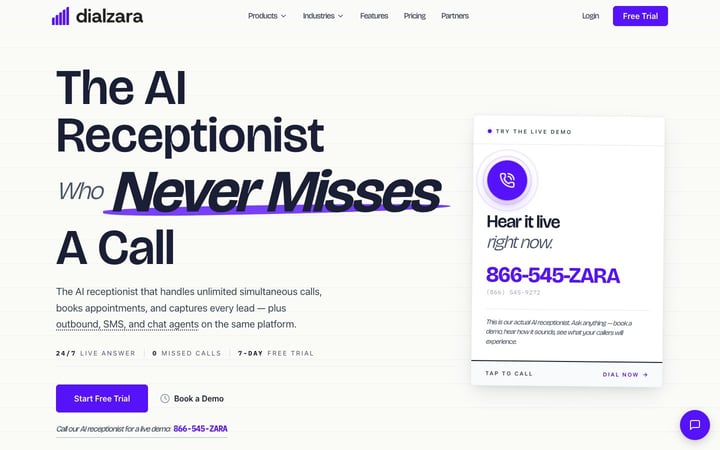
Dialzara bills by the minute. Plans start at $29 a month for 60 minutes and step up to $99 (220 minutes), $199 (500 minutes), and $349 (1,000 minutes), with overage from $0.48 down to $0.35 per minute, plus a done-for-you service from $1,500 a month. Booking, CRM, and calendar integration, plus 24/7 answering in English and Spanish, start on the lowest plan. A separate SMS agent is free with any voice plan.
At 1,500 minutes, the cheapest route is the $349 plan plus 500 extra minutes, about $524 a month.
Dialzara lists blind and warm transfers and API access only on the $349 plan. The pricing page doesn't mention HIPAA, though a Dialzara blog post describes its platform as HIPAA-compliant, so ask for the BAA before any patient calls go through it.
3. Goodcall: for predictable bills when callers phone more than once
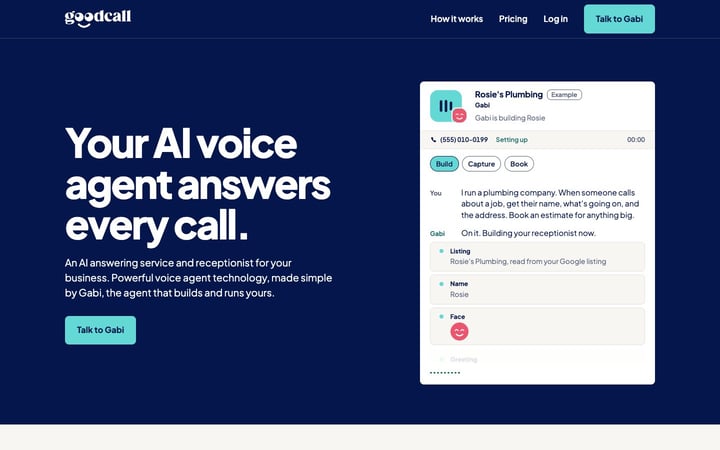
Goodcall bills by unique customers rather than minutes or calls, which suits businesses where the same people call several times a month. Plans start at $79/month for 100 unique customers, $129 for 500, and $299 for 2,000, with overage from 15¢ to 79¢ per extra customer and Enterprise pricing above that. Minutes aren't metered.
It books into Google Calendar, texts you lead details when a call ends, transfers to the right person with a backup number, and sends caller notes to HighLevel. You can keep your existing number by forwarding all calls, or only busy and unanswered ones. Its homepage says it is SOC 2 and HIPAA compliant. At 500 calls, the cost is at most $129 a month, and less if many callers repeat.
The pricing page doesn't show BAA terms or which plans include them, and it doesn't list supported languages.
4. PolyAI: for large contact centers
PolyAI builds voice agents for enterprise customer service in industries such as hospitality, financial services, healthcare, retail, and utilities. Its documentation describes integrations with reservation platforms such as OpenTable, handoff to live agents through contact-center and CRM platforms, and pre-built connections to Salesforce, Zendesk, ServiceNow, NICE, and Twilio. On security, PolyAI lists ISO/IEC 27001, SOC 2 Type II, PCI DSS commitments, and UK Cyber Essentials Plus.
Platform pricing is per minute, but it doesn't publish the rate. You get a quote through its sales team.
Its compliance page says systems are "designed to meet HIPAA requirements" where relevant but doesn't mention a BAA, so healthcare buyers should ask about one.
5. Retell AI: for teams with developers who want to build their own agent
Retell is a voice agent platform, not a finished receptionist. You design the agent yourself, through APIs and SDKs or a drag-and-drop no-code studio, then connect it to your telephony, CRM, and calendars. It can book appointments, send texts, transfer mid-call, and connect to existing phone systems through SIP trunking.
Pricing is pay-as-you-go, from $0.07 to $0.31 per minute, depending on the voice, language model, and telephony you choose, with no minimums and 20 concurrent calls included. At 1,500 minutes, usage runs roughly $105 to $465 a month, before factoring in the time your team spends building, testing, and maintaining the agent. Retell's site lists HIPAA, SOC 2 Type II, GDPR, and ISO 27001, with custom BAA terms on Enterprise.
The per-minute price covers usage only. Budget for the people who will write prompts, connect systems, and own the agent after launch.
6. RingCentral AI Receptionist: for businesses already on RingCentral phones
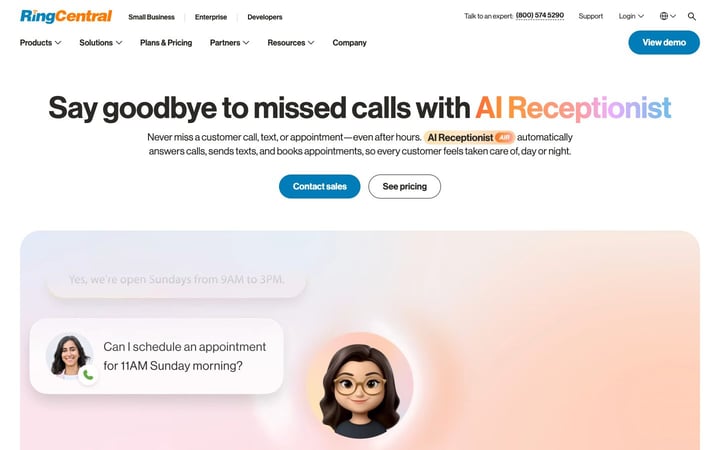
RingCentral sells AI Receptionist as a standalone product or as an add-on to its RingEX phone system in the US and Canada. It routes calls by name, department, location, keyword, or conversation context, and passes your team a call summary with each transfer. It books, reschedules, and confirms appointments in Google and Outlook calendars, sends follow-up texts, and lists six languages (English, Spanish, French, Italian, German, and Portuguese).
Standalone pricing is $49 a month with 100 minutes included; with RingEX it's $39 plus the $30 RingEX Core plan. Extra minutes cost $0.50 each, rounded up to the nearest 30-second increment. At 1,500 minutes a month, that's $749 at list price. Named integrations include Salesforce, HubSpot, and Zoho.
The product page doesn't mention HIPAA, so ask how it applies to AI Receptionist specifically. Per-minute billing with 30-second rounding favors short calls, so check your average call length before comparing it with per-call plans.
7. Rosie: for a low-cost start on minute bundles
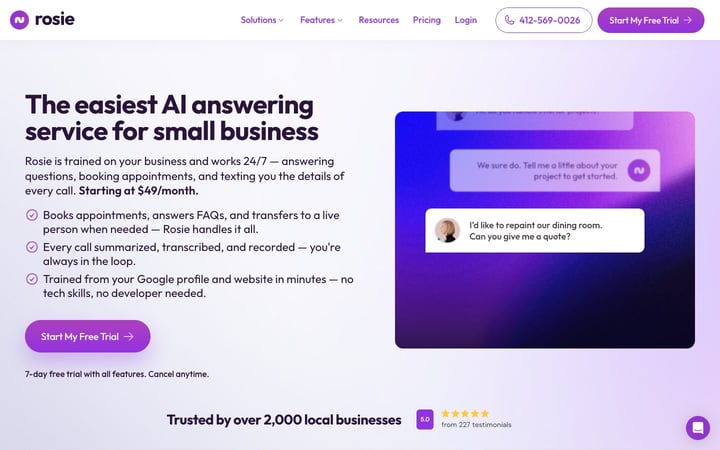
Rosie trains itself from your website and Google Business Profile, answers 24/7 in English and Spanish, and texts you a summary of every call. Plans are $49/month for 250 minutes, $149 for 1,000 minutes, and $299 for 2,000 minutes. Direct calendar booking, warm and live transfers, and in-call texts to callers start on the $149 plan. The $299 plan adds waterfall transfers that try several numbers until someone picks up.
At 500 three-minute calls, the $299 plan covers it. Integrations run through Zapier.
The pricing page doesn't list an overage rate, name the calendars it books into, or describe multi-location routing, and we found no published HIPAA policy.
8. Smith.ai: for when a live person needs to be one transfer away
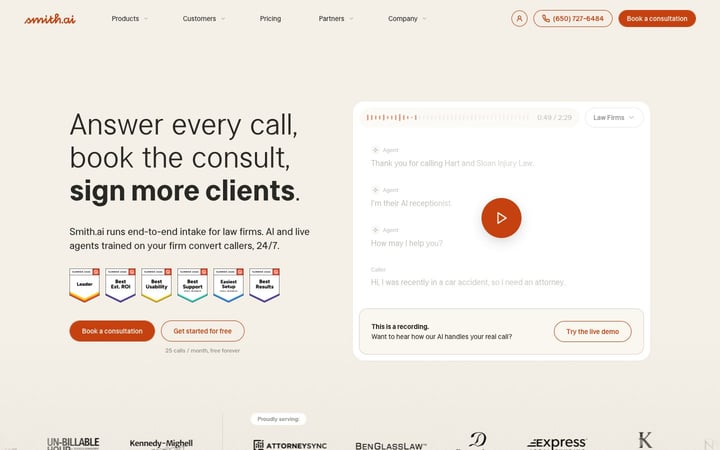
Smith.ai built its business on live virtual receptionists and now sells an AI Receptionist plan alongside them. Its AI answers first, then transfers the call to a live, North America-based receptionist. That makes it a reasonable choice for law firms and professional services where some calls need a human's judgment.
The AI plan bills per call. There's a free tier with 25 calls a month, Pro starts at $150 a month for 75 calls, and Enterprise starts at $500 a month for 300 calls. Overage runs from $2.10 to $3.00 per extra call depending on the tier, and 1,000+ calls a month is custom. Its 500-call Enterprise option lists $1.60 per call, which works out to $800 for 500 calls; the page doesn't state a monthly total for that option. Booking runs through AI scheduling with Calendly and other tools, and native integrations include Clio and Zapier.
The AI pricing page doesn't say whether live-receptionist transfers cost extra, and it doesn't mention HIPAA. If you handle patient information, ask for the BAA position in writing.
9. Synthflow: for enterprises that want a vendor-led build
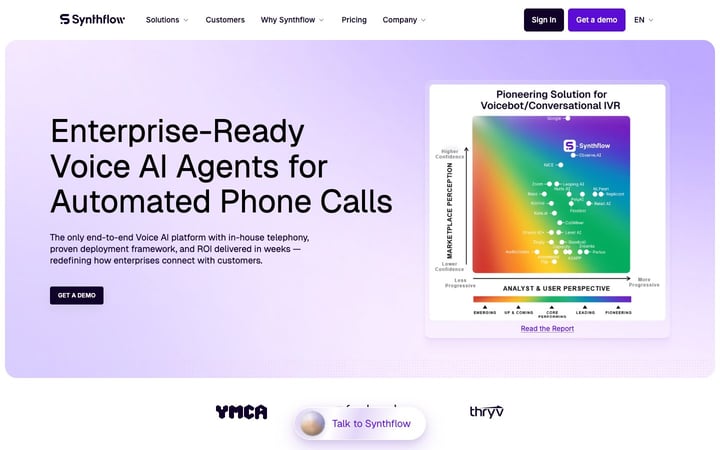
Synthflow sells AI answering as an enterprise contract starting at $30,000 a year, scoped by call volume, concurrency, telephony, integrations, and security needs. It provides forward-deployed engineers to build and launch agents, a visual flow builder, simulated test calls, and its own telephony or SIP trunking. Its pricing page shows SOC 2, HIPAA, GDPR, and ISO 27001 badges, plus EU and US hosting.
Named integrations include Cal.com, GoHighLevel, HubSpot, Salesforce, and Zapier. Out-of-scope calls transfer to a human agent.
With a $30,000-a-year minimum, it's built for large programs. Confirm what launch support includes and what changes cost after go-live.
10. Upfirst: for per-call pricing with steady volume
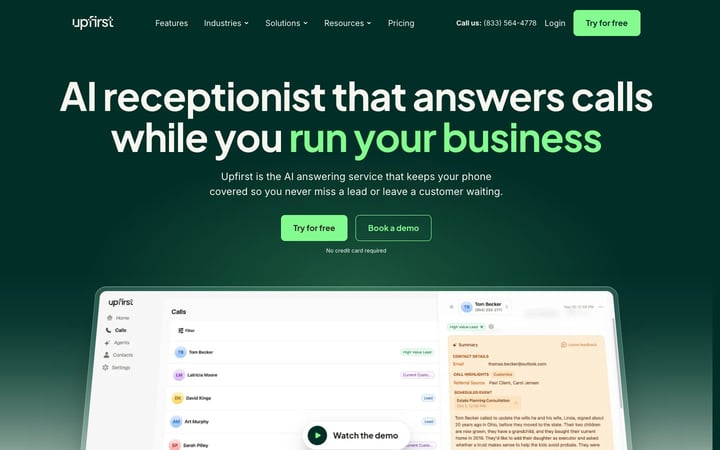
Upfirst bills per call and doesn't count spam or calls under 15 seconds toward your limit. Plans run from $24.95/month for 30 calls to $299 for 600 calls, with overage from $0.70 to $1.50 per call (about 20% less if you pay annually). Every plan includes 24/7 answering, call transfers, booking into Google, Outlook, Clio, Acuity, Calendly, or Square, in-call texting, Zapier, and 35+ languages.
At 500 calls, the $299 Scale plan covers it, or about $240/month billed annually. Custom integrations start at $159.95.
Upfirst lists BAAs only on its Custom plan, so healthcare buyers should start there.
AI vs live answering services: when each wins
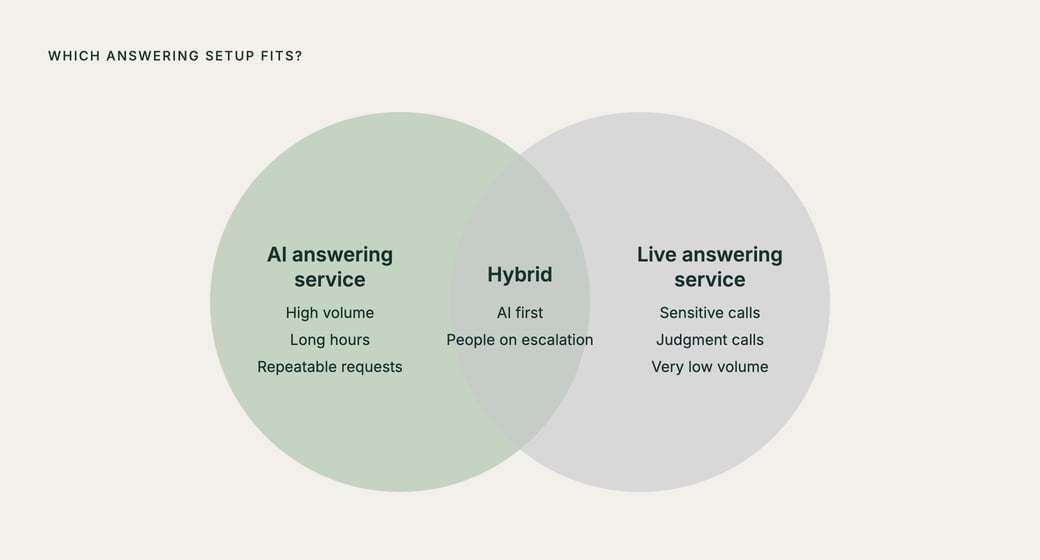
If you're weighing the best answering service for small business or for a larger operation, a live call center is the main alternative to AI. Both have a place, so start with the calls you're trying to cover.
| AI answering service or Voice AI employee | Live answering service | |
|---|---|---|
| Who answers | AI software that holds a spoken conversation | A trained person at a remote call center |
| Simultaneous calls | Many at once, up to the plan's concurrency limit | Limited by agents on shift |
| Nights and weekends | Same service around the clock | Often available, sometimes at a higher rate |
| Booking and records | Writes directly to your scheduler or CRM when integrated | Often books; may relay by message or email |
| Consistency across locations | Same answers from the same approved information | Depends on who picks up and how well they're briefed |
| Typical billing | Per minute, per call, per unit, or contract | Per minute, per call, or monthly bundles |
| Best at | High volume, long hours, repeatable requests | Emotional, sensitive, or unusual calls |
A live service still wins when callers are upset or in crisis; when every call needs judgment you can't write down in advance; or when your volume is so low that a few minutes of human time a day costs less than setting up an AI agent. Several vendors above, Smith.ai most directly, offer a path from the AI to a person for calls like these.
For a baseline, an in-house receptionist earns a median of $18.27 an hour, or $38,010 a year, before benefits and payroll taxes, according to the U.S. Bureau of Labor Statistics (May 2025). That covers one person, about 40 hours a week, answering one call at a time.
A hybrid sits between the two: AI takes first contact, after-hours calls, and overflow, while staff handles escalations and the people in front of them.
Cheapest options and what you give up
If you're looking for the best AI answering service for small business on a tight budget, or a cheap answering service for small business, the lowest-priced monthly plans in this list are Upfirst at $24.95 and Dialzara at $29. Rosie starts at $49, and Goodcall at $79. Two services let you start for $0: Smith.ai has a free AI tier that includes 25 calls a month, then $3.00 per call, and Newo's pay-as-you-go plan includes 50 one-time units, then $1.75 per unit.
Most low entry prices come with limits you'll hit as volume grows. Thirty calls or 60 minutes a month runs out in a few days for a busy front desk, and overage rates on entry plans are often the highest on the rate card.
Features you may need sit on higher plans. In this list, Rosie starts calendar booking and live transfers on its $149 plan, Dialzara keeps warm transfers and API access for its $349 plan, and Upfirst starts custom integrations at $159.95 and lists BAAs only on Custom. Newo's plans share the same core features but differ in volume; outbound calling isn't on pay-as-you-go, and multi-location is on Enterprise. Check multi-location support as well: Rosie's pricing page doesn't describe multi-location routing.
Zapier connects almost anything, but each step adds another connection to monitor. Per-minute platforms have a different catch. Retell's usage price can be the lowest here, but someone on your team has to design and maintain the agent.
A fairer comparison is cost per resolved call. A service that books the appointment during the call can cost more per minute and still cost less per customer than one that takes a message your staff has to return.
How to switch from a live answering service to AI without losing calls
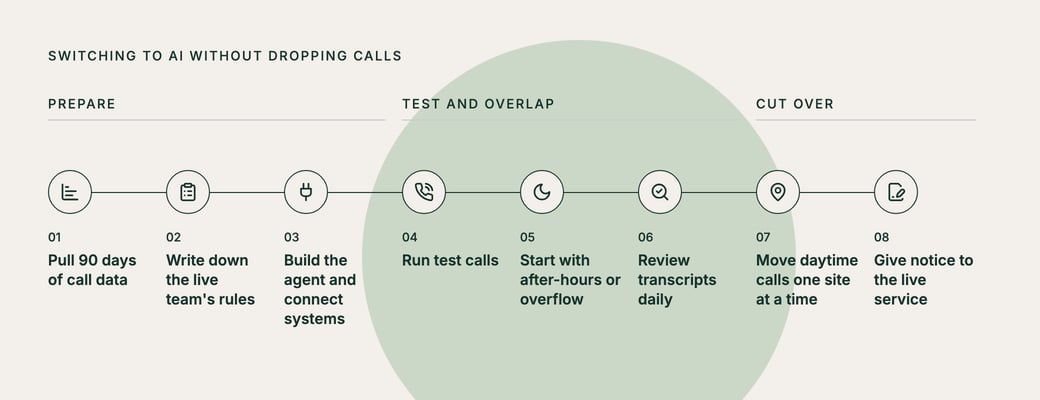
The riskiest parts of the switch are call forwarding and timing, so follow these steps in order.
- Pull 90 days of call data from your current service: call count, average length, peak hours, and the top reasons people call.
- Write down the answers and rules the live team uses, including hours, services, prices, escalation contacts, and anything they're told never to say.
- Build the AI agent from that material and your website, then connect your scheduler and CRM before going live.
- Run test calls covering your top call reasons, plus interruptions, a noisy line, an off-script question, and a request for a person.
- Start with after-hours calls or overflow only. Keep the live service on for daytime calls and use conditional forwarding (busy or no answer) so nothing drops.
- Review transcripts and bookings every day for the first two weeks. Fix incorrect answers in the knowledge base so the correction applies to future calls.
- Move daytime calls over one location or one line at a time. Keep your number, and forward it so callers keep dialing the same one.
- Give notice to the live service only after a full month with no dropped calls, and check its contract for the notice period and porting terms.
If you handle protected health information, get the BAA signed before step 5. The U.S. Department of Health and Human Services says a covered entity needs written assurances, through a contract or other agreement, that a business associate will safeguard that information.
How Newo meets each of the six criteria
All ten services answer calls. They differ in what happens next, and we built Newo for operators with high call volume and more than one site. We held it to the same six criteria as the others.
On booking, Newo reads live availability and writes the booking back to your scheduler while the caller is on the line, then updates the record and sends the confirmation. It names 25+ integrations across scheduling, CRM, field service, and point of sale, including Dentrix, Open Dental, Calendly, Square, and Housecall Pro. The full list is on the Newo integrations page.
When a call needs a person, Newo transfers it and tells the caller first. For several sites, Newo's Enterprise plan routes by location through the AI Call Center, and you manage each site's hours and services from one dashboard. One agent also answers texts and web chat, with the same history as the phone call.
On security, Newo is ISO/IEC 27001:2022 certified and holds a SOC 2 Type 1 report from A-Lign with an unqualified opinion. It signs a BAA before processing any protected health information, acts as a GDPR processor, and uses 256-bit encryption. The rate card is public: pay-as-you-go starts at $0, the AI Receptionist plan is $299 a month for 200 units, and extra units are $1.50. There are no setup fees. Newo doesn't bill for spam (it cuts off within 30 seconds), immediate hang-ups, or calls that never connect, and you can cancel anytime.
Conversations run voice-to-voice with no text step in the middle, keeping turn-taking natural when callers interrupt or change their mind. For more on how AI, live, and IVR options differ, read our guide to virtual receptionists.
Want to hear how it handles calls like yours? Create your own Voice AI employee and put it through the same six checks.
Frequently asked questions
What is the best AI answering service in 2026?
It depends on your call volume, locations, and systems. Businesses with one site and a tight budget can compare the self-serve plans from Dialzara, Goodcall, Rosie, and Upfirst. RingCentral phone customers can add AI Receptionist. Multi-location operators that need booking inside their own systems should compare options such as Newo, PolyAI, Retell AI, Smith.ai, and Synthflow, then run test calls.
What should I look for in AI answering service reviews?
Look for reviews that describe real calls: whether the agent booked correctly, handled interruptions, admitted what it didn't know, and transferred cleanly. Star ratings say little about how it will handle your call types. Ask vendors for a trial number and test it with your own top five call reasons.
How much does an AI answering service cost?
Published entry prices in this comparison run from $0 (Newo's pay-as-you-go starter and Smith.ai's free tier) to contracts from $30,000 a year. At 500 three-minute calls a month, list prices start at about $105 in usage (Retell AI, before build time) or up to $129 (Goodcall) and reach about $2,500 (Synthflow's contract minimum). PolyAI doesn't publish its rate. Billing models differ (minutes, calls, unique callers, or units), so price your real month.
Is an automated phone answering service the same as an IVR?
No. An IVR is a recorded menu that routes callers by keypad or simple voice commands. An AI answering service can hold a conversation, answer questions, and book or update records. Some phone systems market an IVR as a virtual answering service, so ask for a live demo call.
Do callers have to be told they're talking to AI?
For inbound calls, it's good practice to say so in the greeting, and you choose the wording. Outbound calls are stricter: in February 2024, the Federal Communications Commission ruled that AI-generated voices count as "artificial" voices under the TCPA, so consent rules apply.
Can a virtual answering service for small business handle HIPAA calls?
Only if the provider signs a BAA before any patient information goes through it. Several vendors here publish a HIPAA position, but BAA terms often sit on higher plans or aren't published at all. Get the signed agreement and security documentation, such as a SOC 2 report, before you forward calls.