
Dental patient acquisition does not end when someone clicks an ad or calls your practice. To understand whether phone handling supports your marketing, follow new-patient inquiries through callbacks, booked consultations, and attendance.
A prospective patient may call after finding your practice through an ad, search result, or referral. If the call reaches voicemail, the next step depends on whether your team can identify the inquiry and follow up.
The calls your funnel may not show
A caller who leaves no message can be difficult to reconnect with, so voicemail records alone cannot show how many new-patient inquiries your practice receives. Compare incoming-call records with voicemail, callback, and appointment records. A missing message is an incomplete outcome, not proof of a lost patient. Some callers try again or book through another channel.
Caller intent matters too. A caller may be a prospective patient, an existing patient, or someone with another request. Separate new-patient inquiries from other calls before evaluating marketing performance. Otherwise, routine appointment changes and repeat calls can distort the denominator.
Give callers a useful next step
A delayed response may leave an inquiry unresolved; call and appointment records can show whether the practice later reconnects. Make the next action clear, whether it is a supported booking, an answer to an approved practice question, or a callback with an assigned owner.
For an orthodontic practice, an AI receptionist’s configured workflow can include identifying why someone is calling, collecting relevant patient and insurance details for staff review, providing location information, and checking availability for supported consultations. Insurance-data collection is different from confirming eligibility.
Newo’s Cloud 9 integration illustrates why scheduling actions should be checked against the connected practice system. DenteMax call-handling guidance also emphasizes overflow coverage and follow-up.
How to measure dental patient acquisition by phone
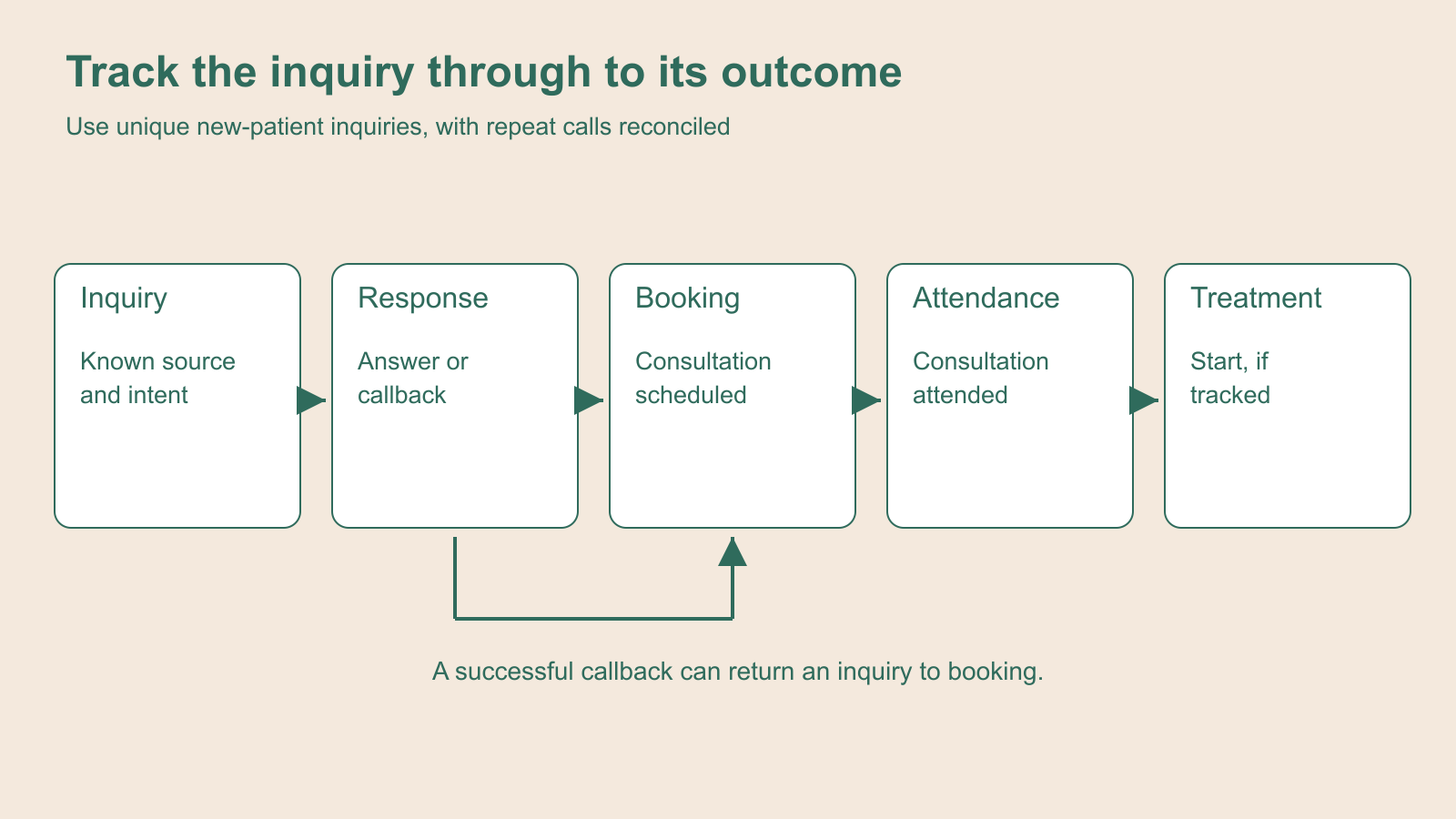
Use one tracking sheet to connect the inquiry to its outcome. Marketing can supply the known source, while front-desk and practice-management records show the response and appointment status.
|
Item |
What to record or do |
Check or owner |
|---|---|---|
|
Inquiry |
Unique caller, date, campaign/source when available, and new-patient intent. |
Marketing owner: deduplicate repeat calls. |
|
Response |
Answered, voicemail, callback attempt, successful callback, or other channel. |
Front-desk lead: reconcile unresolved inquiries. |
|
Appointment |
Booked consultation and attended consultation, recorded separately. |
Practice manager: join to the scheduling record. |
|
Outcome |
Treatment start, if tracked, with an agreed follow-up window. |
Marketing and operations: compare equivalent cohorts. |
Use booked consultations ÷ unique eligible new-patient inquiries as a booking rate. Report attended consultations separately. Do not use every incoming call as the denominator, and do not count a callback-recovered booking as a lost patient. Record unknown marketing sources rather than assigning them to paid ads.
Reconcile before changing the campaign
A booking made after a callback belongs in the result. So does a booking made through another channel after the first call. Keep the follow-up period consistent so a recent inquiry is not compared with one that has had weeks to progress.
If new-patient inquiries are arriving but remaining unresolved, review callback ownership, response expectations, and the actions the phone workflow can complete. If consultations are booked but not attended, investigate that later stage separately. These are different operational questions and may need different changes.
The appointment is a useful milestone, but attendance makes the marketing-to-practice connection clearer. Treatment starts can be tracked as a further outcome when the records and attribution support it.
Improve dental patient acquisition by finding where callers need a better next step. Connect call records to appointments, reconcile callbacks, and test whether the changes help more prospective patients attend a consultation.