
Restaurant call center costs depend on more than the number of locations. Expansion planning should account for call demand, the work automation can complete, and the staff time still needed for exceptions, quality checks, and local changes.
A new restaurant brings its own hours, menu, ordering rules, and customer questions. Shared phone infrastructure may reduce repeated setup, but the expansion budget still needs to show what changes when demand grows.
Separate call demand from location count
Two locations need not generate the same phone workload. Count calls and handling minutes, then inspect the busiest intervals and the requests that require staff judgment. A monthly average alone cannot show whether the existing team can cover several simultaneous escalations.
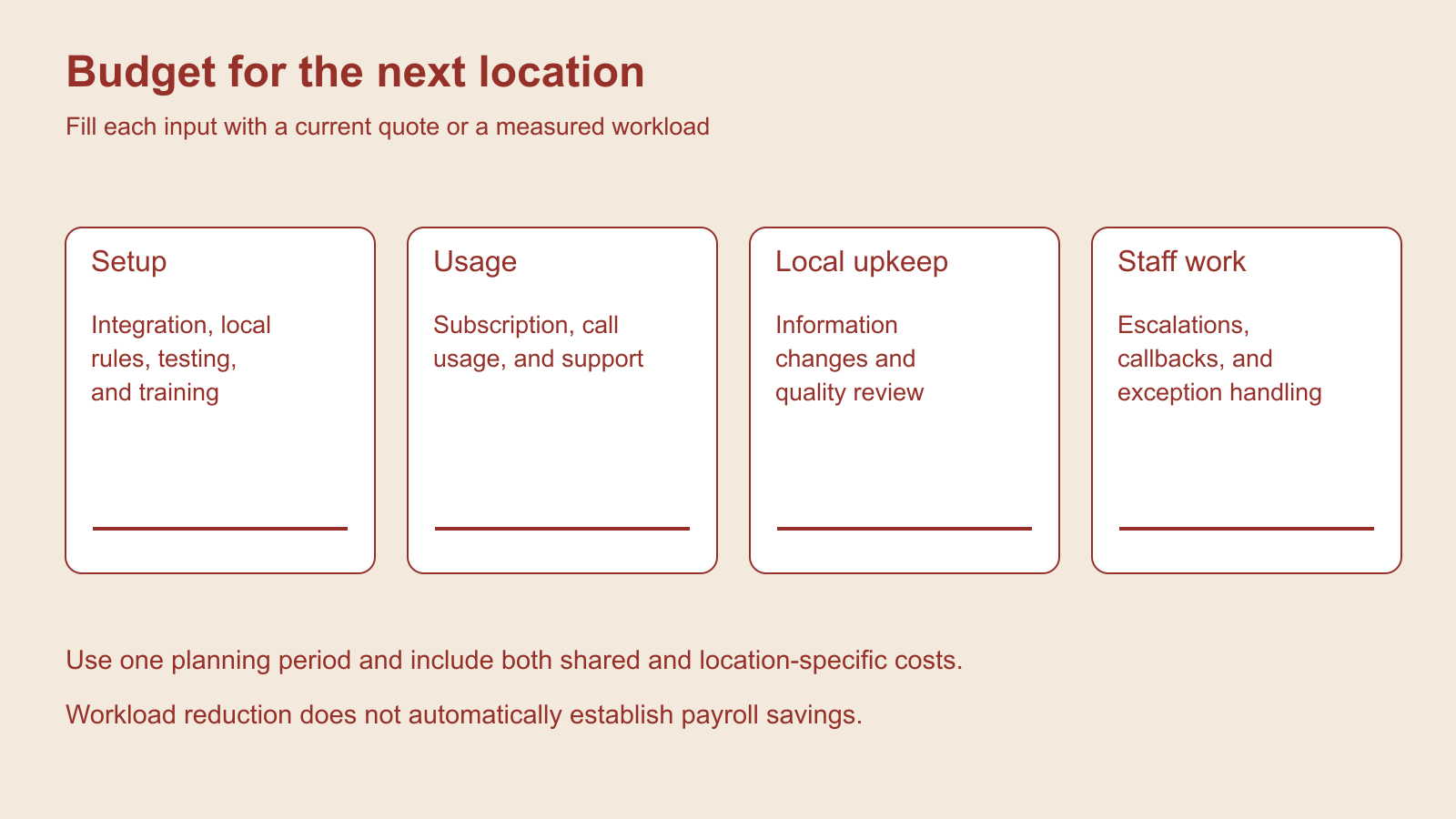
The supporting costs include wages and the time spent training, supervising, updating local information, and resolving exceptions. Automation adds its own implementation, software, usage, and review costs. Both belong in the comparison.
Model restaurant call center costs before expanding
For a chief financial officer (CFO) or chief operating officer (COO), the useful output is a per-location estimate with explicit assumptions. Use the provider’s current quote and the same planning period for each option.
|
Item |
What to record or do |
Check or owner |
|---|---|---|
|
Demand |
Monthly calls × average handling minutes. |
Separate peak intervals and concurrent calls from monthly totals. |
|
Eligible work |
Share of workload covered by approved automated workflows. |
Validate with call samples; do not assume every routine topic is automatable. |
|
Remaining staff work |
Escalations, callbacks, reviews, and local updates. |
Use measured minutes and staffed schedules, not a call-count-to-headcount conversion. |
|
Technology cost |
Subscription, usage, integration, setup, and ongoing support. |
Use the provider’s current quote and a consistent planning period. |
|
Expansion decision |
Incremental cost and available staff capacity for each location. |
Reassess after a pilot; record the assumptions that changed. |
Estimate automated completion from a measured eligible workload and a validated completion rate. Subtract the human work required for reviews and exceptions before claiming time savings. A reduction in workload is not automatically a reduction in employees or payroll.
Restaurant technology research supports evaluating tools against the restaurant’s operating needs.
Share the process and validate local details
Shared infrastructure can reduce repeated setup, but every location still needs validated local information, routing, and exception ownership. A common workflow must lead the caller to the correct location and apply that location’s approved rules.
Newo’s multi-location restaurant guide provides broader deployment context. For expansion budgeting, record which configuration work can be reused and which tasks recur for every opening. That makes local maintenance visible alongside the initial setup.
Budget for the work staff still own
A complicated complaint, unusual request, or decision outside the approved rules may need a manager. Staff also review results, correct information, and handle callbacks. A useful budget includes those responsibilities rather than assuming every answered call removes human work.
Check whether the receiving team has capacity at the times these requests arrive. A reduction in total call minutes does not establish that one person can cover every required shift or location.
Use the pilot to update the expansion plan
Estimate the new location’s call volume, supported automated tasks, and remaining staff workload. Include setup and ongoing review before deciding whether current coverage can absorb the increase.
Compare the total cost of supporting each new location, including software, usage, implementation, quality review, and human escalation. An expansion decision should rest on your workflow and measured costs, rather than another company’s interest in AI.
After the pilot, replace assumptions with observed completion and staff-work figures. A useful expansion plan shows both the work automation absorbs and the work people still own.
Plan restaurant call center capacity alongside each new location’s operating budget. Use measured call workload and a complete cost model to decide where automation helps, where staff remain necessary, and when the plan needs adjustment.