A restaurant phone system needs to work when calls and in-person service peak together. Plan dinner-rush coverage using your own call patterns, available staff time, and kitchen capacity rather than an industry-wide percentage.
Dinner service may concentrate phone demand, but the peak window varies by restaurant. Use your call logs to identify the busiest intervals. A window such as 5 to 8 PM may be useful to inspect, but the restaurant’s own records should determine the plan.
Newo’s busy-hours call guide covers the broader coverage problem; the worksheet below focuses on capacity planning.
Find where calls and floor work overlap
Phone demand competes with floor work during service. The useful question is how much call work arrives at the same time, and which requests need a member of staff.
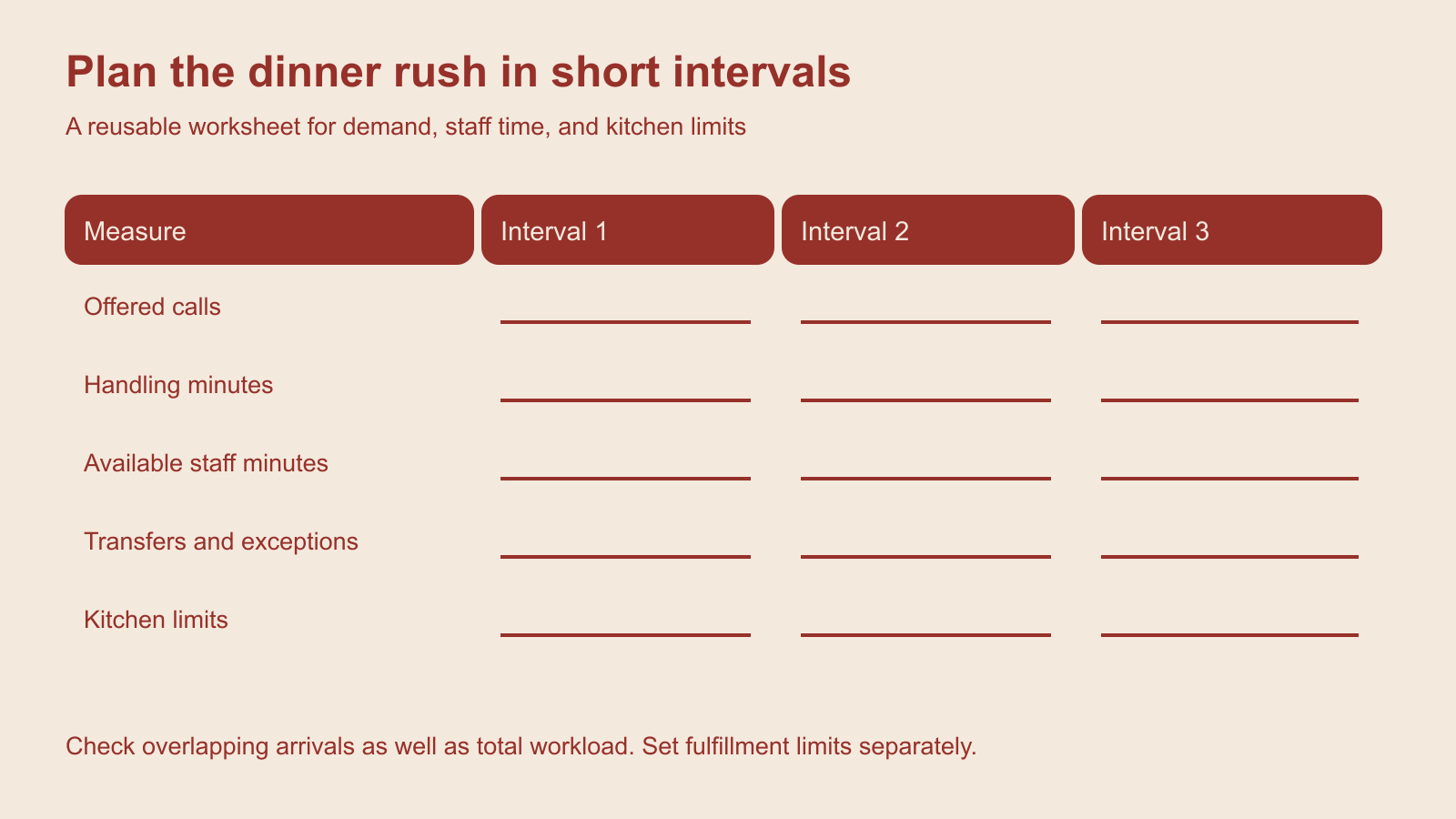
Count incoming calls by short interval and record average handling time and overlapping arrivals. Daily totals can hide a short period in which callers wait or staff are pulled away from service. A manager who appears available in a staffing plan may be dealing with a guest, a kitchen issue, or a staff question when the phone rings.
Size your restaurant phone system for peak demand
Build the plan around both call handling and fulfillment. Answering more callers does not give the kitchen unlimited capacity to accept orders or promise pickup times.
|
Item |
What to record or do |
Check or owner |
|---|---|---|
|
Demand |
Offered calls and overlapping calls in 15-minute intervals. |
Phone-system owner: collect several comparable service periods. |
|
Workload |
Calls × average handling minutes, plus callback and transfer work. |
Operations manager: compare with staff minutes actually available for phone work. |
|
Coverage choice |
Dedicated staff, overflow service, AI, or a combination. |
Manager: compare cost, supported tasks, and exception capacity. |
|
Fulfillment |
Ordering cutoffs, preparation time, and kitchen limits. |
Kitchen lead: approve the rules the phone workflow may promise. |
|
Fallback |
Maximum wait, transfer route, and unavailable-staff response. |
Shift lead: test during concurrent calls. |
Interval workload is a planning input, not a queueing guarantee. Two calls arriving together can still need simultaneous coverage even when average workload looks manageable. Track answered calls, abandoned calls, transfer completion, and kitchen exceptions after changes.
Compare the coverage options
An additional employee can improve coverage when the workload and schedule justify it. Overflow routing or AI may cover some calls, but staff must still be available for exceptions. Compare the options against the work arriving in each interval.
Dedicated phone coverage has a staffing and scheduling cost. An overflow service needs clear instructions about what it may answer or record. AI needs approved information, supported workflows, and a tested handoff when a request falls outside its authority. A combination may fit better than a single approach across every service period.
Restaurant technology research highlights the need to fit tools to the service model and guest preferences.
Test the kitchen and staff limits together
Call-handling capacity and kitchen fulfillment capacity need separate limits. Confirm who updates ordering cutoffs and preparation-time rules, and who receives requests that need a decision.
Test concurrent calls alongside a transfer request. Check what happens when the designated person cannot answer. The fallback should leave the caller with a clear next step and the team with an owned request to resolve.
After changing coverage, compare similar service periods. Look at answered and abandoned calls, completed transfers, and kitchen exceptions. Use those results to adjust routing, staffing, or the supported task list.
Choose a restaurant phone system that fits your busiest intervals and your team’s fallback capacity. Test concurrent calls, transfers, and order limits together so better phone coverage supports service during the rush.