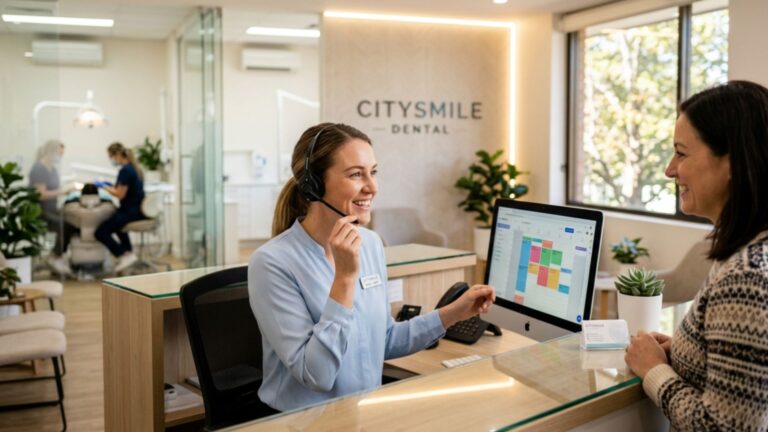
Every missed call at your dental office likely means a lost new patient or an unscheduled treatment, bleeding revenue that doesn’t show up until month-end reports. With after-hours calls, lunch rushes, and sick days piling up, most practices don’t realize just how many opportunities they’re losing-until they count.
A dental office missing patient calls is quietly losing thousands each month in unscheduled appointments, new patient leads, and emergency requests. Most practices underestimate the scope, assuming voicemail or call-backs cover the gap. But audit the call log for a week and you’ll see: many callers never try again, and the majority won’t leave a message. Fixing this bottleneck is one of the fastest ways to boost production without more marketing spend.
Hidden Revenue Left in Missed Calls
Practices that don’t monitor their missed patient calls are leaving easy revenue on the table, especially when it comes to new patient acquisition and reactivation. In our experience, for every five calls missed, at least two represent new opportunities-whether it’s a patient in pain, someone comparing providers, or a family looking to schedule checkups together.
How many dental calls go unanswered?
Data from Dental Economics and actual practice audits show that 20-35% of incoming calls are missed at busy practices, especially over lunch, after hours, or on Mondays. It gets worse if you offer orthodontics or emergencies-those callers expect fast answers and bounce quickly if they don’t get one.
Why patients often don’t leave voicemails
Roughly 80% of potential new patients hang up without leaving a message when faced with voicemail, according to The Doctor Weighs In. They just call the next practice that shows up in their search, especially after hours or during a dental emergency.
What’s the real cost of missing calls?
Each new patient is worth on average $800–$1,200 in the first year. Even missing three new patient calls a week quickly adds up to a five-figure gap each quarter. Existing patients miss out on hygiene appointments, and your unscheduled treatment list keeps growing.
Typical Fixes Don’t Close the Gap
Most dental owners think extending front desk hours, cross-training staff, or hiring an answering service will solve missed patient calls. But real audits show these tactics rarely close the gap entirely-and come with hidden tradeoffs.
Will more front desk staff actually help?
Adding admin FTEs is expensive and doesn’t guarantee coverage during lunch, sick days, or high call volumes. Practices with two or more people at the front still report missing 11-14% of calls during peaks. Besides, those wages stack up fast.
Are traditional call services aligned with dental?
High-volume answering services often sound scripted or generic. Patients can tell, and touch points with low clinical knowledge lead to weak captures or inaccurate notes. Practice managers usually end up calling missed leads back themselves anyway.
Why can’t voicemail pick up the slack?
Most people won’t wait for the beep. Especially not if they’re in pain or anxious about dental work. Voicemail might capture existing patients rescheduling-but it rarely converts new business.
What Happens When You Track Missed Calls
One of the most eye-opening moves for any dental office is to pull a full week of call logs and compare total incoming calls against answered, missed, and new bookings. Honestly, most teams skip this because the data is a pain to gather and more uncomfortable to confront. But that audit gives you your true missed revenue figure, not just a gut check.
How to pull a missed call audit for your practice
Export your phone system’s call log for seven days. Count the total calls, those that rang out more than twice, and all voicemails. Cross-check against your practice management software for new appointments added those same days.
Spotting the hidden impact on patient growth
If you stacked every missed call in a week and compared it to average new bookings, you’d see at least a 20–30% delta-real patients you could’ve had with basic coverage. These gaps rarely show on standard production reports.
Acting before competition does
If you can’t answer patient calls nights, weekends, or in overflow-in our experience, competitors nearby will. Practices in cities, college towns, and suburban corridors lose the most here. The difference is direct: more booked chairs or more empty slots.
How AI Receptionists Recover Lost Revenue (Without More Staff)
Here’s where results get concrete. In production deployments with dental practices, hiring an AI receptionist-think of it as a digital employee built for dental call handling-has delivered lead success scores (conversion to booked appointment or captured lead) of 99.6%, compared to the industry’s ~80% for live front desk teams. Newo.ai’s platform builds this AI receptionist for your practice in under three minutes using just your business name and Google Maps listing.
AI learns your FAQs and protocols-fast
Newo.ai comes prebuilt with 5,000+ edge cases for dental scenarios: insurance questions, emergencies, ortho triage, bilingual support, and after-hours guidance. Your AI receptionist doesn’t just “take a message”-it books appointments, answers eligibility, and responds over voice, SMS, email, and chat right away.
What changes after the AI receptionist starts?
You never miss a new patient inquiry, regardless of when it comes in. Image Orthodontics, for example, saw $401,500 in additional Q1 2025 revenue from 322 new patients-54 booked after normal office hours. And because Newo.ai integrates with your workflow, you don’t have to replace your staff. Instead, your team can focus on in-office service while the AI covers the lines.
Customers won’t hang up-proven in production
In real-world use, over 90% of patients rate their AI receptionist call as “helpful” or “very helpful.” There’s a human-in-the-loop safety net during setup, so complex or angry callers get flagged for manual follow-up. (There are some practices where this level of automation isn’t the right fit-very high-touch fee-for-service clinics, for example-but for most, the operational win is immediate.)
Setup doesn’t eat up your week-just type in your business name and confirm your hours. Most practices go live in under three minutes. No IT hassle, no major workflow changes.
Want to see how this fits dental? Read more about the dental AI receptionist deployment details.
Your Next Steps: Fast Audit, Quick Win
Now that you know what missed calls are costing, here’s what works if you’re serious about fixing it-without overhauling your whole front desk:
- Do a 7-Day Missed Call Audit: Look at your phone log, compare to bookings, and tally unscheduled opportunities.
- Have your office manager test Newo.ai’s free trial: Set up an AI receptionist using only your Google Maps listing. No contracts, no IT headaches.
- Track conversion for new patient inquiries: See which calls are booked that would’ve gone to voicemail before-most practices see their first win in 2–3 days.
- Review workflow adjustments: You may want to tweak follow-up routines or cross-train staff on overflow protocols, even after AI is active. (This is my non-product advice: keep clarity in your call-back policy, so nothing slips between layers.)
You’ve done the research. Now it’s time to see the results for yourself.
One Dental Practice Added $401,500 in Revenue: Image Orthodontics captured 322 new patients in Q1 2025-54 from after-hours calls alone-using Newo.ai. Your practice is losing similar opportunities right now.
Create your AI receptionist in 3 minutes-no credit card required, no complex setup. Just enter your business name and watch your AI employee get to work.
Turn Patient Calls Into Booked Appointments, 24/7
Every call that gets answered-on the first ring, with actual scheduling power behind it-means more patients in the chair, higher treatment acceptance, and less staff burnout from playing phone tag. Dental practices that pinpoint and patch the missed-call gap outperform their competitors by a wide margin. If you want to see proof, run the numbers for your own location. And if you’re ready to take the next step, there’s never been an easier way to make every call count.
Learn more about dental AI receptionist technology and how AI receptionists for dental offices translate directly into booked patients. For broader strategies across service businesses, check out our insights on AI appointment scheduling and after hours answering service for SMBs.
And if you’re not sure where to start, start by counting missed calls. That alone will tell you if something needs fixing.