Dental insurance verification is the check a practice runs before an appointment to confirm that a patient's plan is active and what it will pay for the planned treatment. You can automate most of it with verification software, an outsourced service, or AI agents, as long as you collect the right details when the patient books.
Verification answers two questions: is this patient covered on the date of service, and how much of this procedure will the plan pay?
What does dental insurance verification involve?
Verification has two parts. Eligibility confirms the plan is active on the date of service. The benefits breakdown shows what the plan pays for each kind of treatment, and it is the part that takes the front desk's time.
A full breakdown covers these items:
- Active coverage on the date of service, and the plan's effective date
- Subscriber ID, group number, payer, and network status
- Annual maximum and the amount remaining
- Deductible and the amount already met
- Coverage percentages by category: preventive, basic, major, and orthodontic
- Frequency limits and age limits for cleanings, X-rays, fluoride, and sealants
- Waiting periods
- Missing tooth or pre-existing condition exclusions
- Alternate benefit and downgrade rules
- Coordination of benefits when a patient has two plans
- Pre-authorization or pre-treatment estimate requirements
The National Association of Dental Plans defines most of these terms in its glossary of dental insurance terms.
Eligibility has a standard electronic format. Under HIPAA, health plans answer eligibility questions through the ASC X12N 270/271 transaction: the practice sends a 270 inquiry and the plan returns a 271 response. The response is quick, but it often leaves out procedure-level detail, which is why staff still log in to payer portals or pick up the phone.
All of it depends on what the patient gave you at booking. If the subscriber ID or date of birth is wrong, every later step fails, so verification begins on the phone. That is one reason groups add an AI receptionist (or as we call it, a Voice AI employee for dental practices), such as Newo, to the front desk.
What does manual verification cost a dental group?
Checking one patient manually, by phone, mail, fax, or email, takes a dental provider about 12 minutes and costs $6.52 in staff time, according to the 2024 CAQH Index, which reports 2023 data. A payer portal or automated phone line takes 7 minutes and $4.37. A fully electronic check takes 4 minutes and $2.53.
Take a group with 10 locations, each seeing 40 insured patients a day over 250 working days. That is 100,000 verifications a year.
| Method | Minutes per verification | Cost per verification | Staff hours a year | Staff cost a year |
|---|---|---|---|---|
| Phone, mail, fax, or email | 12 | $6.52 | 20,000 | $652,000 |
| Payer portal or automated phone line | 7 | $4.37 | 11,667 | $437,000 |
| Fully electronic | 4 | $2.53 | 6,667 | $253,000 |
Moving this example group from portals to fully electronic checks would free about 5,000 staff hours a year. Swap in your own patient counts to see your figure.
The same report explains why offices have not all made that move. In 2023, 82% of dental verifications were fully electronic, 15% went through portals or automated phone lines, and 3% used phone, mail, fax, or email. CAQH found that dental providers kept using portals because electronic responses often lacked the detail they needed. Across the industry, CAQH put the remaining savings from automating dental verification at $580 million a year.
Manual work also has costs that no benchmark captures. A missed frequency limit or waiting period can turn into a denied claim and a balance the patient wasn't expecting.
What are your options: in-house, outsourced, software, or AI?
Most practices choose between four approaches, and many groups combine two. The right mix depends on patient volume and on how much detail your treatment plans need. It also matters whether results have to land in the practice management system (PMS) without retyping.
| Option | How it works | Best fit | Limits |
|---|---|---|---|
| In-house team | Front-desk or billing staff check portals and call payers | Complex treatment plans that need a full breakdown and a person's judgment | Time grows with patient volume and pulls staff away from patients |
| Outsourced verification company | A remote team does the portal and phone work and returns a breakdown form | Groups that want full breakdowns without adding front-desk hours | Turnaround time, and results may need retyping into the PMS |
| Verification software | Real-time 270/271 eligibility checks, built into or connected to the PMS | High volumes of routine visits, often run in a batch against tomorrow's schedule | Responses can lack procedure-level detail |
| AI agents | Software agents collect details from patients, log in to portals or call payers, and structure the breakdown | Groups that want both the patient call and the payer check handled without extra headcount | Needs accuracy checks and a clear route for exceptions |
What to compare in dental insurance verification services
A dental insurance verification service takes the portal and phone work off your team. When you shortlist dental insurance verification companies, ask each one the same questions:
- How far ahead of the appointment do you need the schedule, and how fast do results come back?
- How deep is the breakdown form, and can we add our own fields?
- Do results write into our PMS, or do we retype them?
- Is pricing per verification or per month, and what counts as a re-verification?
- Will you sign a business associate agreement (BAA) under HIPAA?
The best dental insurance verification companies for a multi-location group are the ones that can show accuracy on your own payer mix. Ask each dental insurance verification company for a trial on a week of real appointments, then compare the results with what your team finds.
What to compare in dental insurance verification software
Most dental insurance verification software checks eligibility in seconds, so it suits routine visits. Compare products on five points: whether they return eligibility only or a full breakdown, which payers they cover, whether results write back to the PMS, whether they can run a batch against the schedule, and how they charge. The best dental insurance verification software for your group is the one that covers your top payers at the level of detail your treatment coordinators use.
Where AI insurance verification for dental practices fits
Dental insurance verification AI covers two jobs. Some agents work the payer side: they log in to portals or call payer phone lines and fill in the breakdown. Others work the patient side, collecting insurance details on the call so the check can start. Judge both on the same points as software and services, plus two more: how the vendor measures accuracy, and what happens when the agent can't finish a check.
How can you capture insurance details on the first call?
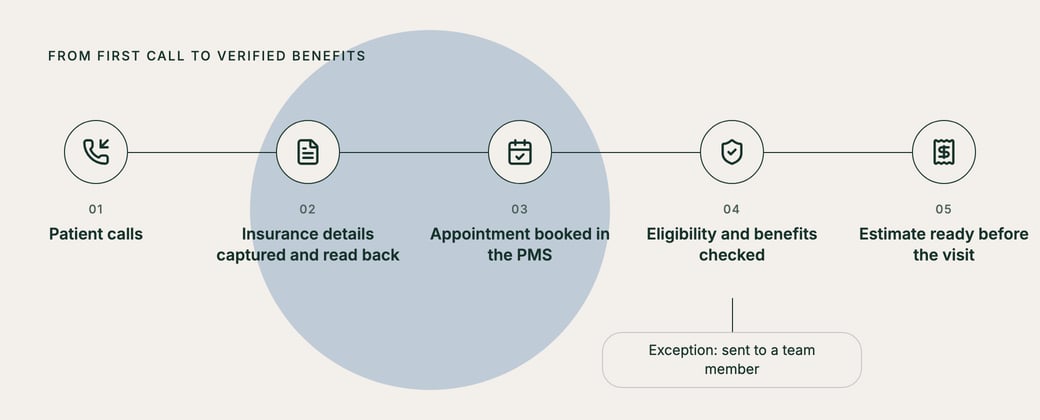
Collect the subscriber's details while the patient is booking, read them back, and save them with the appointment. A verification that starts with complete data is less likely to need a second call to the patient.
A Voice AI employee can run this intake on every call, including the ones that arrive after hours. It can book the appointment into the practice management system and answer insurance questions during the same call.
A first-call intake follows six steps:
- Ask whether the patient has dental insurance and who the subscriber is.
- Collect the subscriber's full name and date of birth, and the patient's relationship to the subscriber.
- Collect the insurance company, subscriber ID, and group number, and read each one back.
- Ask about a second plan, so you know early whether coordination of benefits applies.
- Note the reason for the visit, so the check covers the right procedure category.
- Save everything with the appointment and tell the patient what happens next.
You can pass these details straight to whichever verification method you use. The same intake works for after-hours patient calls, which might otherwise go to voicemail.
What should an implementation checklist include?
Count what you do today before you buy anything. Then automate the routine checks and keep people on the exceptions.
- Count verifications per location per week, and how many are done by phone, portal, or electronically.
- List your top payers by patient volume.
- Agree one breakdown form for every location.
- Decide which visit types need a full breakdown and which need eligibility only.
- Set a deadline for verification before each appointment.
- Choose who owns exceptions, such as inactive coverage or a missing subscriber ID.
- Add insurance intake to the booking script for calls and online forms.
- Confirm PMS write-back with every vendor, so no one retypes results.
- Get a signed BAA from every vendor that touches patient data.
- Run a trial at one location and compare results with your team's own checks.
- Track minutes per verification, exception rate, and eligibility-related denials each month.
- Tell patients their estimate before the visit, using automated reminders where you already send them.
How Newo's Voice AI employee supports dental insurance verification
Newo's Voice AI employee covers the call-side steps of the checklist above.
- For insurance intake at booking (step 7), it answers the call, books the appointment, and adds the insurance details the patient gives to the appointment notes. This works through the Cloud 9 and Denticon integrations.
- For booking into the PMS, which supports step 8, it writes the appointment into the practice management system your front desk runs, including Open Dental and Dentrix.
- For exceptions (step 6), it can pass the caller to a team member when a question needs a person.
- For the signed BAA (step 9), Newo's security covers ISO/IEC 27001:2022, SOC 2 Type 1, HIPAA with a signed BAA, and GDPR, with 256-bit encryption.
- For insurance questions, it answers them during the call from the information you give it.
Conversations run voice to voice, so the agent stops when the patient starts speaking.
Newo doesn't verify insurance itself. Your eligibility software or verification service still does the checking, and your team starts from the details in the appointment notes.
Want to hear how a booking call sounds for your practice? Create your own Voice AI employee and test it on a new-patient booking.
Frequently asked questions
What is dental insurance verification?
It is the check a practice runs before an appointment to confirm a patient's dental plan is active and to find out what the plan pays for the planned treatment. It covers eligibility, annual maximum, deductible, coverage percentages, frequency limits, and waiting periods.
How long does dental insurance verification take?
The 2024 CAQH Index, which reports 2023 data, puts the provider's time at about 12 minutes for a manual check, 7 minutes through a payer portal or automated phone line, and 4 minutes when the check is fully electronic. Complex treatment plans can take longer.
Can dental insurance verification be automated?
Yes, for most routine visits. Most software returns eligibility in seconds, and AI agents can collect patient details and gather the breakdown from payers. Complex cases, such as two plans or major treatment, still benefit from a person's review.
What is the difference between eligibility and benefits verification?
Eligibility confirms the plan is active on the date of service. Benefits verification shows what the plan pays: the annual maximum, the deductible, coverage percentages, and the limits that apply to each procedure.
How is insurance verification in dental different from medical?
Most dental plans work around annual maximums, frequency limits, and waiting periods, so the breakdown matters more than the yes-or-no eligibility answer. Dental offices also rely on payer portals more often, because electronic responses can lack procedure-level detail.
Should a multi-location group use a dental insurance verification service or software?
Many groups use both. Software handles routine visits in a batch against the schedule, and dental insurance verification services or in-house specialists take the cases that need a full breakdown. Decide by counting how many of your visits fall into each group.