Orthodontic practices may not realize how much revenue a missed call can cost. A phone rings while the front desk is checking in a patient. Another call comes through while the team is helping someone with paperwork. After hours, a prospective patient reaches voicemail.
To estimate the cost of missed calls, an orthodontic practice needs to follow the path from an unanswered inquiry to a consultation and a treatment start. This guide shows how to use your own call records and conversion rates.
What one unanswered call can put at risk
A prospective patient may call about braces, Invisalign, a consultation, or treatment pricing. They have contacted the practice to ask about treatment. A missed call risks losing that opportunity, although some callers try again or book through another channel.
Estimates of $850 in immediate revenue opportunity per missed new-patient call and $8,000 to $25,000† in potential lifetime value show why phone coverage deserves attention. Treatment, future services, and referrals can contribute to patient value, but an unanswered call does not automatically mean that value has been lost.
Using $850 as an illustrative assumption, the arithmetic looks like this:
|
Assumed missed new-patient calls |
Illustrative opportunity at $850 each |
|---|---|
|
Five in a week |
$4,250 |
|
Five per week over four weeks |
$17,000 |
|
Ten in a month |
$8,500 |
|
Twenty in a month |
$17,000 |
These examples retain the same dollar assumption; they do not account for callbacks or the likelihood of starting treatment. A calendar month longer than four weeks could produce a total above $17,000 at the same weekly pace, but use actual call counts for the period you are measuring.
Treatment revenue may be collected over months or years. Use expected collections after discounts and write-offs for case value, and keep future referrals and other family members separate unless your records support an estimate without double-counting. The American Association of Orthodontists explains that treatment cost varies with the type, complexity, and duration of care, which is another reason to use your practice's own case values.
† Dollar figures are based on the average value across all Newo orthodontic/dental customers.
Estimate the cost of missed calls in your practice
Start with one month's unanswered calls. Group repeat contacts about the same prospective patient into one inquiry, and remove existing-patient and non-patient calls from the acquisition calculation. Then check whether the person later booked through a callback, repeat call, or online booking. A parent may call for more than one child, so a phone number alone is not a reliable patient count. Keep unidentified callers in an unknown group.
The American Association of Orthodontists' 2025 survey summary, using 2024 practice data, estimated 44,000 exams and 28,000 treatment starts associated with its Find an Orthodontist tool. That works out to about 64 starts for every 100 reported exams. It is a ratio of aggregate estimates for that referral source, not a tracked patient-cohort conversion rate or a missed-call benchmark. Exams and treatment starts belong at different steps in your calculation.
Potential treatment collections at risk = unrecovered prospective-patient inquiries × inquiry-to-booked-consultation rate × consultation attendance rate × attended-consultation-to-treatment-start rate × expected collected revenue per case.
Use fully followed-up, comparable patient records for each rate. Divide bookings by identified inquiries, attended consultations by bookings, and treatment starts by attended consultations. Allow a consistent follow-up period and keep patients still awaiting a decision separate.
A worked example
Suppose a monthly review finds 20 unique prospective-patient inquiries initially unanswered, with five subsequently recovered and booked. That leaves 15 unrecovered inquiries. Every input below is hypothetical.
|
Input |
Illustrative assumption |
|---|---|
|
Unique prospective-patient inquiries initially unanswered |
20 |
|
Already recovered and booked |
5 |
|
Remaining unrecovered inquiries |
15 |
|
Inquiry-to-booked-consultation rate if reached |
50% |
|
Booked-consultation attendance rate |
80% |
|
Treatment-start rate among attended consultations |
40% |
|
Expected collections over each treatment case |
$6,000 |
15 × 50% × 80% × 40% × $6,000 = $14,400 in modeled treatment collections at risk.
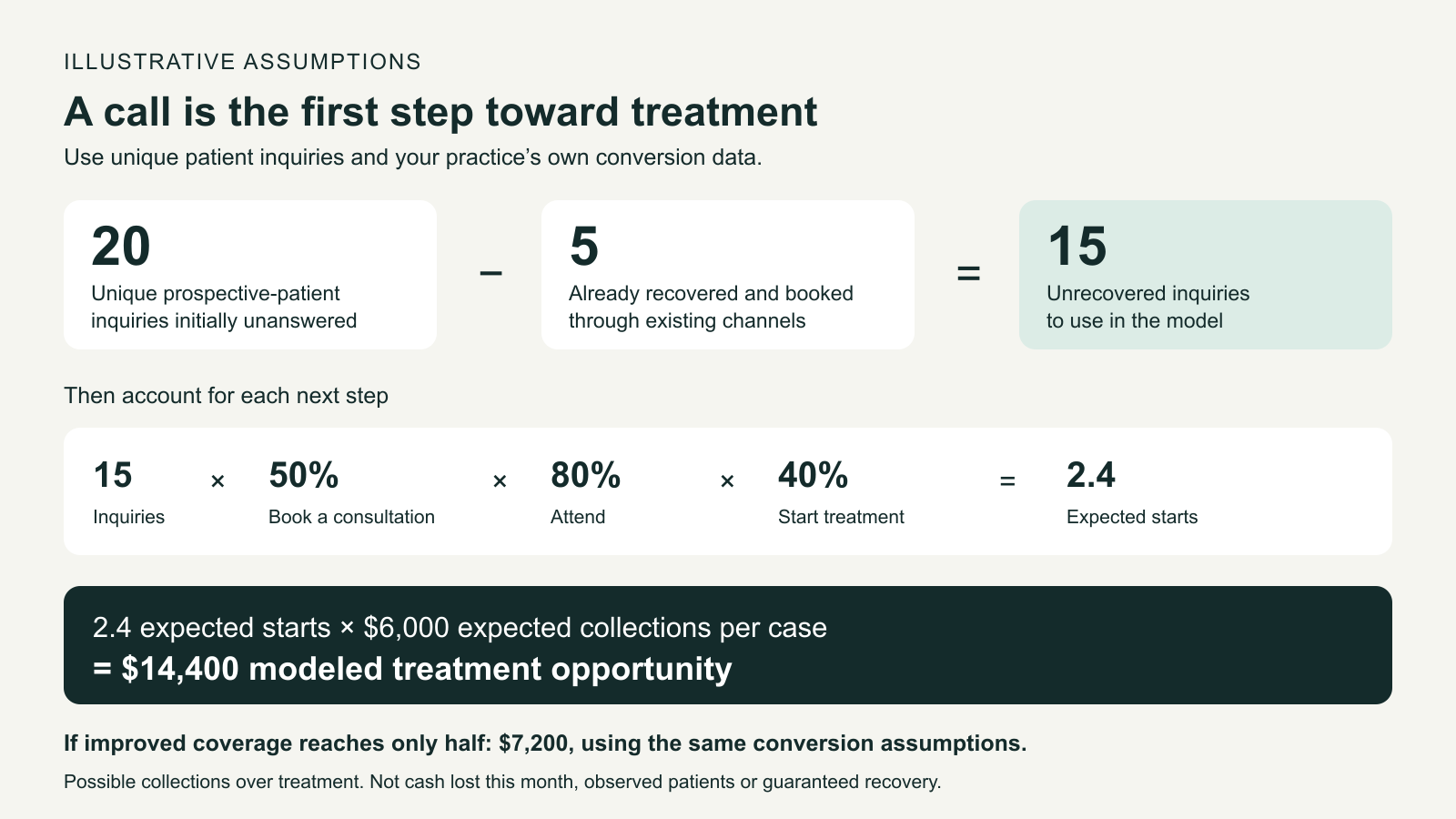
The result is equivalent to 2.4 expected treatment starts across many comparable situations. It is not a count of actual patients or cash lost during the month. If improved coverage successfully reaches only half of those unrecovered inquiries, and the same conversion assumptions apply, the modeled opportunity is $7,200.
The calculation assumes those callers would convert like a comparable reachable group. Actual outcomes can differ. A patient's suitability for treatment and decision to proceed remain separate from answering the call, and the new workflow should not receive credit for callbacks that already succeeded.
Find the calls your team needs help covering
Front-desk teams check patients in and out, schedule appointments, confirm visits, answer questions, process payments, coordinate with clinical staff, and handle insurance-related tasks. When someone needs help in person and the phone rings, the caller may have to wait.
After hours, the practice needs a defined response and follow-up process. A parent researching treatment at 7 p.m. may call immediately and contact another practice if no one answers. A voicemail still needs timely follow-up.
Have the practice manager review the previous 30 days of call records and appointment outcomes. Record:
- Call time, location, and whether the call was answered.
- Identified purpose and the prospective patient involved.
- Repeat contacts, callback attempts, and whether the inquiry was recovered.
- Confirmed consultation, attendance, and treatment start.
- Unknown intent and outcomes still awaiting follow-up.
Separate business-hours overflow from calls outside each location's opening hours. Assign a staff owner to unanswered inquiries and agree on when callbacks must happen. Review whether callers leave a message, receive a callback, book later, or remain unresolved. A message taken is not a confirmed appointment.
|
What the audit shows |
First change to evaluate |
How to judge it |
|---|---|---|
|
Calls missed during busy check-in periods |
Adjust phone responsibility or provide overflow coverage |
Compare unanswered-call rate in those periods and subsequent confirmed consultations. |
|
Unrecovered inquiries cluster after closing |
Test after-hours coverage with a staff callback path |
Track unique inquiries, bookings, and unresolved requests outside opening hours. |
|
Calls are answered, but consultations remain low |
Review inquiry handling, appointment availability and follow-up |
Check inquiry-to-booking conversion before adding answering capacity. |
|
Appointment or patient matching fails |
Correct the integration and escalation rules before expanding |
Verify the patient, location, and appointment; review exceptions with staff. |
How we helped Image Orthodontics capture $401,500 in additional revenue
In Q1 2025, our Voice AI receptionist helped Image Orthodontics generate $401,500 in additional revenue by handling overflow and after-hours calls. Across the quarter, it handled 10,865 calls, including 1,563 after-hours calls. Read our Image Orthodontics case study.
After-hours calls accounted for 14.4% of the calls our AI receptionist handled—roughly one in seven. Over the three-month period, that averaged 521 after-hours calls per month. For Image Orthodontics, those were hundreds of conversations each month that could be answered outside regular office hours.
Choose a coverage workflow to test
Answering creates a chance to understand the caller's request and agree on a next step. Newo can support overflow and after-hours calls, including 24/7 coverage. Whether it books an appointment or routes the request to staff depends on the supported integration and the practice's configured workflow.
Before a pilot, check Newo's integrations directory and confirm the exact actions supported for your software and locations. For example, Newo's Cloud 9 integration can search availability and book supported visits under practice-defined rules. Its documented search window is configurable up to seven days. This example is specific to Cloud 9; other integrations can support different actions.
Newo supports the team's telephone work; staff continues handling in-person care, payments, insurance questions, and exceptions.
Compare a 30-day pilot with a comparable 30-day baseline, allowing equal follow-up time for consultations and treatment decisions. Extend follow-up when needed rather than treating pending decisions as lost patients. Report counts as well as rates, and note changes in marketing, hours, appointment capacity, or staffing. Use your practice's baseline rather than an assumed industry target.
To judge the financial return, compare additional revenue collected, minus treatment delivery costs, with the added cost of coverage, setup, and staff follow-up over a consistent period. Keep already-spent marketing costs separate so you don't count the same loss twice. Continue only if the additional confirmed outcomes and manageable staff follow-up justify the cost.
Start with a review of last month's unanswered inquiries to estimate the cost of missed calls in your practice. Then bring the busiest periods and unresolved requests to a Newo demo to discuss which coverage workflow to test.