
Call center automation across multiple locations needs a repeatable rollout process and clearly owned local rules. Start with the tasks the system may complete, the requests staff must handle, and the tests each location must pass before going live.
Each new location adds local information, routing decisions, and staff responsibilities. A rollout process makes those requirements visible before calls are redirected. A repeatable workflow can reduce the setup needed for each location, while staff remain responsible for exceptions and local changes.
Define the work the system may complete
Start with the requests customers make: hours, directions, pricing, service areas, scheduling, rescheduling, and status updates. The topic alone does not tell you whether the system can handle the request.
Classify work by the action and authority required: approved information only; a supported system action under explicit rules; or a request requiring staff judgment. The same topic can fall into different categories. A published opening time may be straightforward to answer, while a customer-specific scheduling exception may need a person.
Configure the right rules for each location
Choose a shared or location-specific configuration based on the supported integration and routing design. Each location still needs accurate hours, services, availability, and escalation rules.
Newo’s call-center offering provides context for supported routing and operational workflows. The rollout should make clear which information is shared, which rules belong to a location, and who keeps those details current.
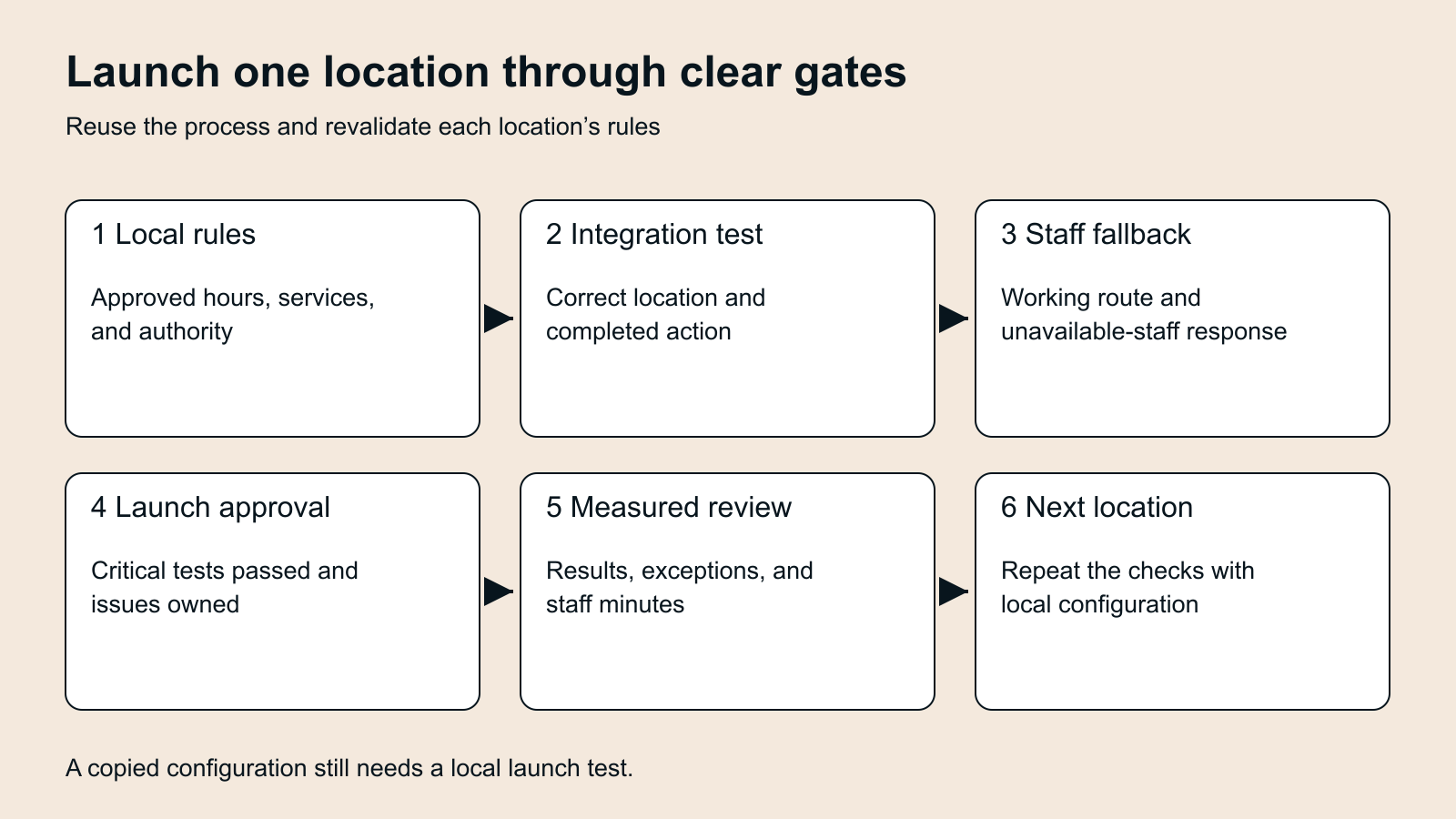
Use a repeatable process: location setup, AI configuration, call routing, approved task handling, human escalation, and performance monitoring. Revalidate local permissions, integrations, and fallback routes before enabling a new location; copying configuration is not a completed launch test.
A call center automation launch checklist
Use one launch record for every location so responsibility and unresolved issues are visible before calls move to the new workflow.
Item |
What to record or do |
Check or owner |
|---|---|---|
Rules and source |
Hours, services, prices, service area, and scheduling rules. |
Local manager owns the approved source and update date. |
Permitted actions |
Information-only answers and supported system changes. |
Business owner records the authority boundary and exceptions. |
Staff route |
Escalation destination, availability, and fallback. |
Shift owner tests successful transfer and unavailable-staff handling. |
System check |
Correct location, identity, availability, and completed record update. |
Implementation owner records expected and actual test results. |
Launch gate |
All critical tests pass and unresolved issues have an owner. |
Operations owner approves the location and defines pause/recovery actions. |
Review |
Completed tasks, failures, staff interventions, and staff minutes. |
Named reviewer checks early results before the next location launches. |
The NIST AI Risk Management Framework is a reference for assigning ownership, measuring performance, and managing changes.
Measure the work that remains
Measure handling time as well as call count. A large number of short routine calls may consume less time than a smaller number of complex requests. Compare the staff minutes removed with the minutes still required for escalations, callbacks, and quality review.
Estimate net staff minutes saved as baseline minutes for the matched eligible workload minus staff minutes still spent on that workload after rollout, including review and exceptions. Adjust for changes in call demand. Do not convert that estimate directly into a headcount reduction without considering schedules and required coverage.
Call volume is one planning input. Also measure duration, concurrency, supported actions, and exception work. A location with fewer calls can still need substantial staff attention when those calls involve judgment or difficult handoffs.
Expand after reviewing the first locations
Once a workflow is tested, reuse its structure and revalidate the rules for the next location. This approach can fit franchises, home services, healthcare networks, property services, automotive businesses, and field service operations that share repeatable tasks.
The review should show which requests were completed, which reached staff, and which remained unresolved. Correct the recurring issues and retest the affected workflow before copying it across more locations. Staff should know who can pause a workflow and how calls will be handled while it is corrected.
Expand call center automation when each location can pass the same operational checks with its own rules and staff routes. Measure completed work and remaining staff time, then use those results to plan the next rollout.