
To get more HVAC leads, first stop losing the ones you already pay for, then add channels. Count the calls, forms, and voicemails that never became a booked job. Fix that leak, and each dollar you spend on Google Business Profile, Local Services Ads, reviews, and referrals goes further.
An HVAC lead is a person who has contacted you about a repair, a replacement, or a maintenance plan and has not booked yet.
How many HVAC leads are you already losing?
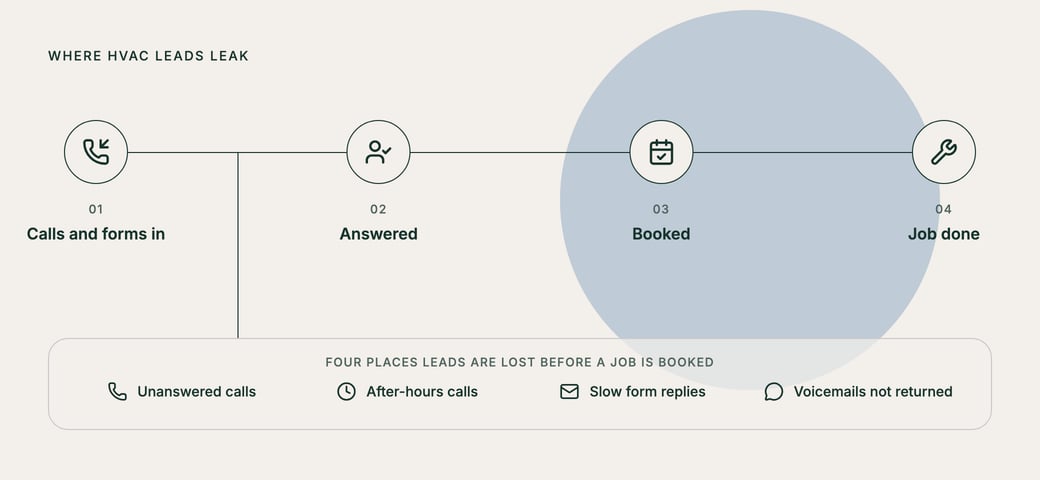
Look for lost leads in four places: calls nobody answered, calls that came in after hours, web forms that waited for a reply, and voicemails nobody returned. Run this audit for one month before you buy more leads.
- Pull a month of call logs from your phone system. Count new-job calls, and how many your team answered live.
- Split the unanswered calls into business hours and after hours.
- For web forms and messages, record the time between the request and your first reply.
- Count voicemails, and how many got a call back the same day.
- For answered calls, count how many ended with a booked job.
Two numbers come out of the audit. Your answer rate is the share of new-job calls a person or an agent picked up. Your booking rate is the share of answered calls that became a job.
At 1,000 new-job calls a month and a $450 average ticket, the two scenarios compare like this:
| Scenario | Calls answered | Jobs booked | Monthly revenue |
|---|---|---|---|
| 80% answer rate, 60% booking rate | 800 | 480 | $216,000 |
| 95% answer rate, 60% booking rate | 950 | 570 | $256,500 |
| Difference | 150 | 90 | $40,500 |
In this example, answering 150 more calls adds 90 jobs and costs nothing extra in advertising. Run the audit before you write the HVAC marketing plan. Lost calls are also why many operators put an AI receptionist (or as we call it, a Voice AI employee for HVAC and plumbing teams), such as Newo, on the lines their office can't cover.
Which channels bring in HVAC leads?
For most HVAC businesses, six channels do the bulk of the work: your Google Business Profile, Local Services Ads, reviews, referrals and partnerships, maintenance plans, and text follow-up. Start with the two Google channels, because that is where many people search when the heat or the air conditioning fails.
| Channel | What it is good for | What to do first | What to measure |
|---|---|---|---|
| Google Business Profile | Free calls from local searches and the map | Complete every field, add service areas, post photos of real jobs | Calls and direction requests per location |
| Local Services Ads | Paid calls and messages at the top of results | Turn on message leads and answer every call during your ad schedule | Cost per booked job |
| Reviews | Can lift both Google channels | Ask every customer on the day of the job | New reviews per month, per location |
| Referrals and partnerships | Low-cost, high-trust jobs | Offer property managers and builders one named contact | Jobs per partner |
| Maintenance plans | Repeat work in slow months | Offer a plan at the end of every repair visit | Plans sold per technician |
| Text follow-up | Reaches people who didn't answer | Text back after a missed call or an open estimate | Replies that become bookings |
Google Business Profile
Google ranks local results on three things: relevance, distance, and prominence, according to its guide to local ranking. You can't change distance, so work on the other two. A complete profile helps relevance. Google says more reviews and positive ratings can help prominence. A company with several locations needs a profile for each one, and a page on its site for each city it serves.
Local Services Ads
Local Services Ads charge per lead, and the price varies by location, job type, and lead type. Google can charge for a call you missed: if the caller stays on the line for more than 20 seconds during your business hours, it counts as a lead, according to Google's page on how leads work.
Missed calls also cost you position. Google's page on ad rankings says missed calls may hurt your responsiveness, which feeds into where your ad appears. Rating, review count, and average response time count too.
Reviews, referrals, and maintenance plans
Ask for a review on the day of the job, while the customer still remembers the technician's name. Send a link by text. Google lets you ask for reviews but does not let you pay for them, and you may not ask only happy customers.
Referrals grow when a partner has one person to call. A property manager with 150 units wants a number that someone answers and a contractor who shows up. Maintenance plans do a similar job with homeowners: they turn a single repair into visits every spring and fall.
Text follow-up
Some people won't pick up a call from a number they don't know, and a text gives them another way to reply. Use it after a missed call, after an estimate, and before the season starts. Get consent first. Under FCC rules, marketing texts sent with an autodialer need the customer's prior express written consent, so collect it on your forms and at booking, and check your wording with counsel.
How do you turn more calls into booked jobs?
Answer faster, ask fewer questions before you offer a time, and give every caller a next step. HVAC lead generation gets a caller to dial, and the call decides whether you get the job.
Work on three things:
- Answer rate. Staff the phones to your call pattern. The audit shows which hours you miss most.
- Booking rate. Give the person answering a short script: confirm the problem, confirm the address, offer two time windows, and take the booking before quoting anything complex.
- Speed to lead. Reply to web forms and messages while the person is still looking. Someone with no heat often contacts several companies, and the first one to offer a time often gets the job.
HVAC customer service also shapes the next lead. A customer who got a clear arrival window and a tidy job is more likely to leave a review and take the maintenance plan.
Write a separate rule for emergencies. Decide what counts as one, who is on call, and how the caller reaches that person at 2 a.m. If your team can't take those calls, plan cover for after-hours calls.
How do AI answering and follow-up get more from your lead spend?
A Voice AI employee answers the calls your team can't reach and follows up on the leads your team has no time to chase. Your ad budget stays the same while more of the calls it pays for become jobs.
It can do four jobs in a lead process:
- Pick up when the office line is busy or closed, find out what the job is, and book a window.
- Send emergencies to the on-call person.
- Call a new web lead back as soon as the form arrives. See how this works for quote requests.
- Work through stalled estimates and no-answers by call, and stop when the customer replies.
People stay on the work that needs them, such as complex quotes and commercial accounts. An HVAC business owner still decides the script and what counts as an emergency.
How do you track which channel produces booked jobs?
Track cost per booked job for every channel. Cost per lead alone can hide the channels that send calls nobody books.
- Give each channel its own phone number, so you know where a call came from.
- Record the source on every job in your field service software.
- Each month, list spend, leads, answered leads, and booked jobs per channel.
- Divide spend by booked jobs.
- Move budget toward the channels with the lowest cost per booked job, and fix answering before you cut a channel that sends unanswered calls.
For a company with several locations, run the same table per location. One branch with a low answer rate can make a good channel look bad across the group.
What should the first 30 days look like?
Spend the first week on the audit, the next two on fixes, and the last on tracking.
- Week 1: run the lead leak audit and write down your answer rate and booking rate.
- Week 1: complete every Google Business Profile, one per location.
- Week 2: set a rule that every new-job call gets an answer during your ad schedule.
- Week 2: add consent wording to forms and booking, then start missed-call and estimate follow-up by text.
- Week 3: ask for a review after every finished job.
- Week 3: offer a maintenance plan at the end of every repair visit.
- Week 4: set up one phone number per channel and the monthly table.
- Week 4: compare cost per booked job by channel and location, then move budget.
How Newo's Voice AI employee helps you keep the HVAC leads you pay for
Newo's Voice AI employee covers the answering and follow-up steps in the audit and the 30-day plan.
- For unanswered and after-hours calls (audit steps 1 and 2), it answers, works out what the job is, offers windows your crew can make, and books before the call ends.
- For emergencies, it sends the call to your on-call person and tells the caller before it transfers.
- For web forms (audit step 3), it calls the lead back as soon as they submit the form, qualifies the request, and books or routes it.
- For stalled leads (week 2 of the plan), it retries no-answers by call and replies to texts from the same agent, and scheduled follow-up stops when the lead responds.
- For booking, it reads live availability and writes the job back to field service tools such as Housecall Pro and ServiceM8.
Conversations run voice to voice, so the agent stops when the caller starts speaking. Newo's security covers ISO/IEC 27001:2022, SOC 2 Type 1, HIPAA with a signed BAA, and GDPR, with 256-bit encryption.
Consent for marketing texts and your review requests stay with your own process. Ask any vendor, Newo included, how it records opt-outs.
Want to hear how it answers a no-heat call? Create your own Voice AI employee and test it with one of your own service calls.
Frequently asked questions
How can I get HVAC leads?
Start with the leads you already have: answer every call, reply to forms fast, and return voicemails the same day. Then build your Google Business Profile, run Local Services Ads, ask every customer for a review, and set up referrals with property managers and builders.
How much do HVAC companies pay for leads?
It depends on the channel and the market. Google does not publish a price list for Local Services Ads; it says lead prices vary by location, job type, and lead type. Compare channels on cost per booked job, which you can work out from your own spend and bookings.
What is HVAC lead generation?
HVAC lead generation is the work of getting homeowners and businesses to contact you about heating and cooling jobs. It includes local search, paid ads, reviews, referrals, and follow-up with people who asked for a quote and didn't book.
What is the $5,000 rule in HVAC?
It is a rule of thumb for repair or replace decisions. Multiply the age of the unit in years by the repair cost. If the result is more than $5,000, replacement may make more sense. We found no industry body that sets the rule, so treat it as a starting point for the conversation with the customer.
Does the same approach work for a plumbing business?
Yes. A plumbing business gets urgent calls in the same way, so the audit, the channels, and the tracking table apply without changes. Only the emergency rules and the seasonal offers differ.
Should I buy leads from a lead service?
You can, but run the audit first. If your team misses calls or replies slowly to forms, bought leads leak in the same places as the ones you earn. Fix answering and follow-up, then test a lead service against your cost per booked job.