
Contact center ROI is easier to understand when you track which calls produce results and what they cost. For a regional or multi-location business, that starts with identifying missed inquiries and following them through to completed work.
Staffing costs, response times, and average handle time help managers run a contact center efficiently. A phone call can also involve a sales opportunity, a renewal, an appointment request, or a customer trying to resolve a problem before leaving. Treating those interactions purely as costs can overlook commercially valuable inquiries.
Broader AI research offers context, but it cannot establish the return from your phone operation. In November 2024, Microsoft reported that an IDC study it commissioned found an average return of $3.70 per dollar invested in generative AI, rising to $10.30 among leading adopters.
Where regional operators can find missed opportunities
Consider a hypothetical regional plumbing and heating, ventilation, and air-conditioning company with 15 locations. An unanswered call may be a new service inquiry, a question about an existing job, or a repeat attempt from the same customer. Some callers may choose a competitor; others may book online or call back. Classifying those outcomes is the first step toward estimating the value of better coverage.
Alongside familiar contact center metrics such as response time and cost per contact, ask: which unfinished interactions involve a genuine sales or retention opportunity? Review these categories:
- Calls that arrive after business hours
- Calls that go unanswered during peak periods
- Customers who abandon lengthy hold times
- Callers transferred multiple times before giving up
- Existing customers who leave because issues weren't resolved
These situations identify interactions worth investigating; they do not establish a lost sale. Some unanswered inquiries become booked work through another channel; others do not. Track what happens next before assigning them a revenue value.
Define recovered revenue before measuring it
Cost per contact measures the operating cost allocated to each handled contact. For the same period and call group, also track confirmed bookings, completed transactions, and revenue net of cancellations and refunds.
Revenue associated with a covered call is attributed revenue. Call it incremental recovered revenue only when a comparison with the previous process supports the additional amount. If you report recovered revenue per handled contact, divide that incremental revenue by all contacts handled in the defined pilot group, and state the period and denominator.
Tracking efficiency and business outcomes together gives managers a fuller view of the operation. When comparing call center ROI across locations, use the same cost definitions and outcome measures. Keep retained renewals separate from new bookings so the same transaction is not counted twice.
How to estimate contact center ROI from missed inquiries
Look at one month's call data and ask four questions:
- How many calls arrived after hours?
- How many went unanswered?
- How many customers abandoned the queue before reaching someone?
- How many calls occurred during periods when staffing was stretched thin?
Estimate the share of unique missed inquiries that qualify for service, the additional booking rate better coverage could produce, and the share of bookings that become completed work. Apply the average net transaction value to completed work, then compare the resulting contribution with the full cost of the additional coverage.
|
Input |
Evidence to use |
|---|---|
|
Unique inquiries |
Deduplicated phone and customer relationship management (CRM) records |
|
Qualification share |
Reviewed inquiry outcomes |
|
Incremental booking-rate change |
Pilot versus a comparable baseline or control |
|
Completion rate |
Completed-job records linked to bookings |
|
Average net value and contribution margin |
Finance records, net of cancellations and refunds |
The operations owner joins the records; finance confirms the cost and margin treatment.
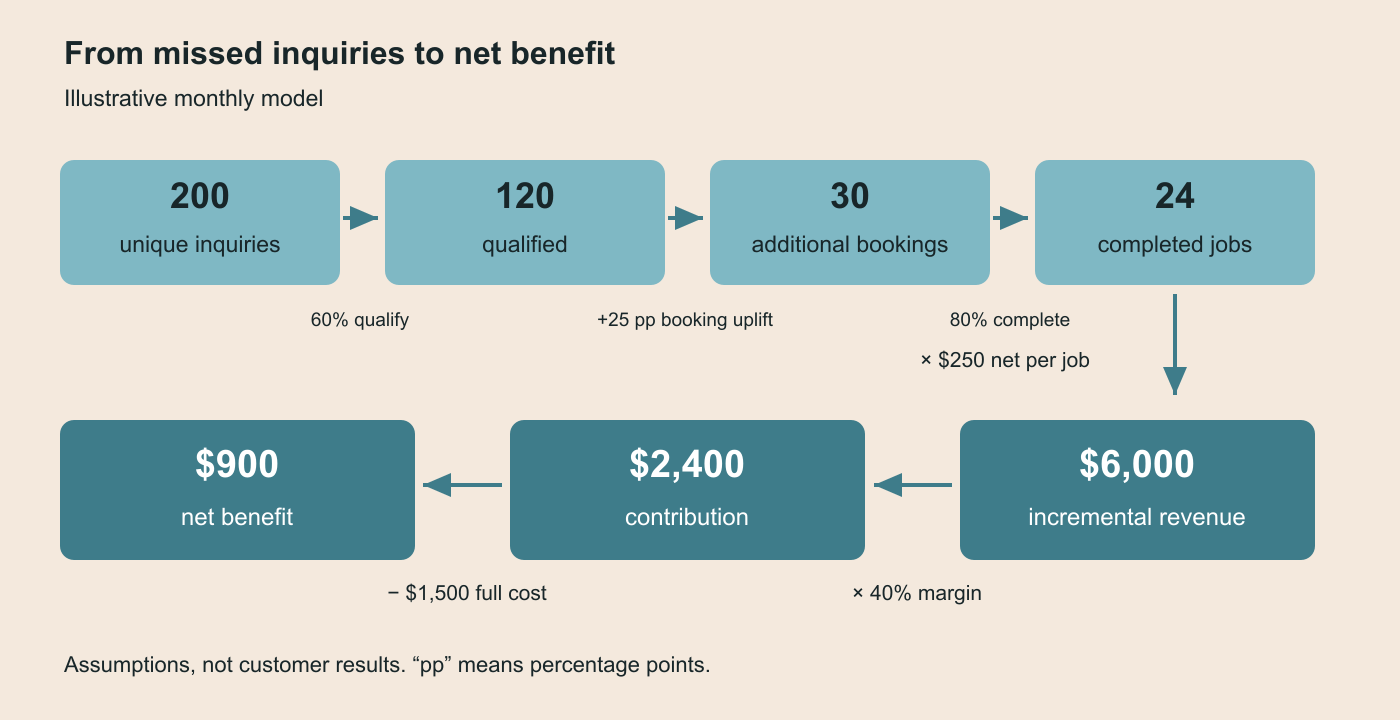
Illustrative monthly example. Deduplicate missed calls into 200 separate inquiries. Assume 60% are qualified service opportunities, additional coverage raises their booking rate by 25 percentage points relative to the current process, and 80% of those additional bookings become completed jobs. At $250 net revenue per completed job, the estimate is 200 × 60% × 25% × 80% × $250 = $6,000 in additional earned revenue. That represents 30 additional bookings and 24 completed jobs, not 200 lost sales.
At an assumed 40% contribution margin before the new coverage costs, those jobs contribute $2,400. If the pilot costs $1,500 for the month, including software, telephony, setup allocation, review and incremental handoff work, net benefit is $900. Pilot return on investment (ROI) is ($2,400 − $1,500) ÷ $1,500 × 100 = 60%.
Where AI and staff fit in
Peak demand and after-hours inquiries can exceed available phone coverage. For example, a regional service business could use a voice agent to answer overflow inquiries after 6 p.m. Where a supported scheduling connection and booking rules are configured, it can offer available slots and create a booking. Requests outside those rules need a staff handoff or a recorded follow-up request.
The same coverage question arises in restaurants and other appointment-based businesses, but each workflow needs its own setup and testing. Check the scheduling system in Newo's integration directory, then verify the specific actions and account setup needed for the pilot.
Regional operators can evaluate additional phone coverage against their own demand, fulfillment capacity, and operating costs. A pilot should establish whether the workflow produces enough additional completed business to justify the investment. Staff remain responsible for exceptions, urgent requests, service delivery and supervision; include that ongoing work in the cost model.
Use a pilot scorecard before expanding
|
Measure |
Definition and evidence |
Decision supported |
|---|---|---|
|
Coverage |
Answered eligible calls / eligible incoming calls, by location and hour, from telephony logs |
Is the chosen gap being covered? |
|
Booking completion |
Confirmed bookings / unique qualified inquiries, linked to booking IDs |
Do conversations produce real next steps? |
|
Fulfillment and net revenue |
Completed jobs and revenue after cancellations/refunds, linked to the pilot group |
Do bookings become business? |
|
Incrementality and contribution |
Pilot change versus comparable baseline/control; revenue contribution less full added coverage costs |
Expand, revise or stop? |
|
Handoff quality |
Transfers reaching the intended staff destination / attempted transfers; log unanswered handoffs and complaints separately |
Do exceptions reach a person reliably? |
Assign an operations owner, select one overflow or after-hours call group, and set the comparison window and success criteria before launch. Test an unavailable slot, an unsupported request, and an unanswered transfer. Review results by location and demand period; use your own baseline rather than an assumed industry threshold. Staff own exception handling, configuration updates, and service fulfillment.
The scorecard may require joining data from telephony, CRM, booking, and finance records.
Start with one month's call records and one defined coverage gap. Use the pilot scorecard to measure contact center ROI before expanding, then explore how Newo could support that workflow.